Nov. 07, 2024

5 minutes read
Share this article
Imagine this: a company wants to launch a groundbreaking product. They pour time, energy, and resources into development, only to find that the product doesn’t meet customer needs. What went wrong? Often, it’s because they skipped a critical step—understanding their customers deeply. This is where Design Thinking Strategy transforms how businesses approach challenges and create solutions.
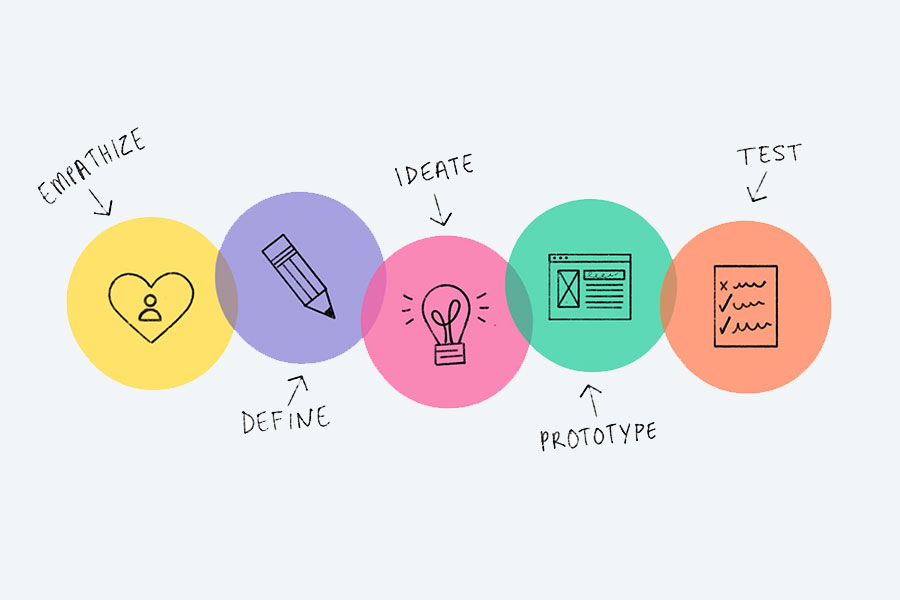
In this guide, you’ll explore how design thinking shapes business strategy, why it’s crucial for success, and how its five steps—Empathize, Define, Ideate, Prototype, and Test—can lead to transformative outcomes across industries. Plus, learn how businesses leveraging staff augmentation or software outsourcing can benefit from the Design Thinking framework.
Design Thinking is a human-centered approach to problem-solving that focuses on understanding the end user’s needs. It emphasizes creativity, collaboration, and iteration, ensuring that solutions are innovative but also practical and user-friendly.
This process isn’t just for designers—business leaders, developers, and strategists across industries use design thinking frameworks to improve products, services, and company culture.
When applied to business strategy, design thinking bridges creativity and practicality. Here’s why it’s a game-changer:
Let’s explore the five steps of the design thinking framework and how they contribute to a winning business strategy.
Software development teams can create more intuitive and efficient applications by integrating the design thinking framework. From prototyping UX designs to testing functionality, the process ensures that every feature serves a purpose.
Companies outsourcing their development projects benefit from design thinking because it promotes clear communication and shared goals. External teams can quickly understand the problem and deliver solutions that align with the client’s vision.
Hospitals use design thinking to improve patient experiences, such as streamlining appointment scheduling or enhancing telemedicine interfaces.
Retailers apply it to design customer-centric shopping experiences in physical stores or online.
Airbnb is a classic example of how design thinking can transform a business strategy. Early in its journey, the company struggled to gain traction. The founders decided to visit users and empathize with their frustrations.
This led to a redefined problem statement: Hosts needed help showcasing their spaces effectively. After ideating and prototyping solutions, they improved the platform with features that made listings more visually appealing and user-friendly.
Today, Airbnb is a global leader in the travel industry thanks to its design-thinking mindset.
Design Thinking Strategy is a proven method for solving complex business challenges. By following its five steps—empathy, Definition, Ideation, Prototyping, and Testing—businesses can create innovative solutions that resonate with users.
Whether leveraging IT Staff Augmentation to scale your team, working with dedicated delivery squads, or outsourcing software development, design thinking provides a roadmap to success.
Ready to unlock your business’s potential? Start applying design thinking today and pave the way for innovation and growth.
Mike is an experienced full-stack marketing professional who brings deep experience in leadership roles for high-growth organizations in the technology space. For more than 15 years, he’s led successful marketing teams in Latin America and the USA. Specialized in Digital Marketing, with a strong emphasis on scaling B2B technology companies via growth marketing, he’s developed marketing initiatives for companies like Hewlett-Packard, Unilever, Coca-Cola, Mondelez, Chrysler, Beiersdorf, and Colgate.
Mike is an experienced full-stack marketing professional who brings deep experience in leadership roles for high-growth organizations in the technology space. For more than 15 years, he’s led successful marketing teams in Latin America and the USA. Specialized in Digital Marketing, with a strong emphasis on scaling B2B technology companies via growth marketing, he’s developed marketing initiatives for companies like Hewlett-Packard, Unilever, Coca-Cola, Mondelez, Chrysler, Beiersdorf, and Colgate.
Accelerate your software development with our on-demand nearshore engineering teams.