Apr. 09, 2026

13 minutes read
Share this article
Last Updated April 2026
As of 2026, companies are under pressure to release digital products faster, integrate AI features without destabilizing core systems, and improve customer experience across every touchpoint. That pressure has made full-stack web development a business decision, not only a technical one.
A full-stack approach gives one team — or, in some cases, one developer — the ability to work across the user interface, application logic, APIs, data models, and deployment workflows. For firms planning custom software development, that breadth can reduce handoff delays and shorten the path from idea to production.
The market signals are clear. The U.S. Bureau of Labor Statistics projects 15% employment growth for software developers, QA analysts, and testers from 2024 to 2034, with an average of about 129,200 openings each year. Stack Overflow’s 2024 developer survey found that full-stack developers remained the largest single developer group at 31% of respondents — and in 2025, 65% of them reported using or actively exploring AI tools. McKinsey’s 2025 State of AI found that 88% of organizations use AI in at least one business function, with software engineering among the most common areas of adoption.
Those figures point to the same conclusion: businesses need development capacity that can connect product, data, infrastructure, and speed.
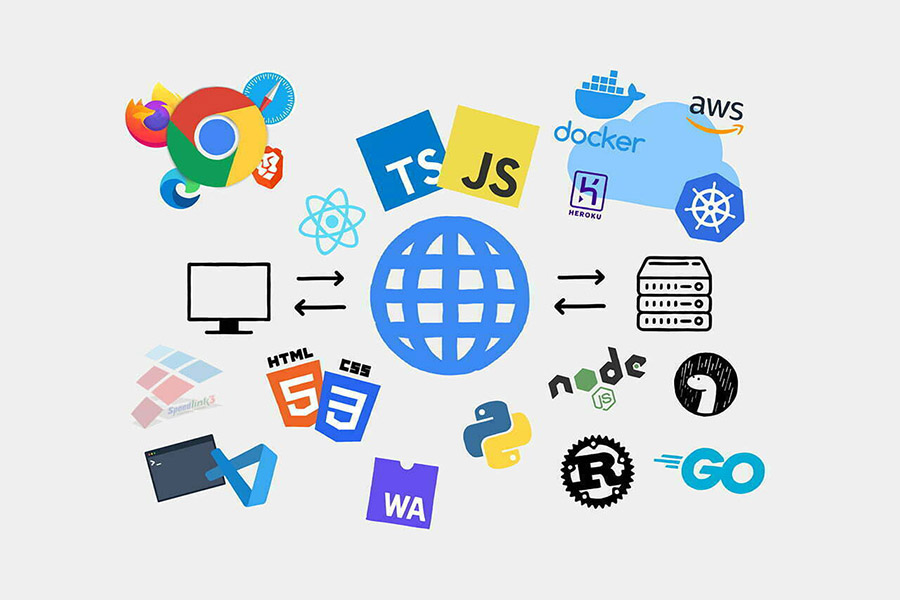
Full-stack web development covers both the client-side and server-side of a web application. On the front end, it includes interface design, browser performance, accessibility, and responsiveness — built using technologies like React, Angular, and Vue.js. On the back end, it includes application logic, databases, security controls, API integrations, and deployment, powered by runtimes and frameworks such as Node.js, Python, Ruby on Rails, and PHP.
In commercial terms, it means one delivery function can own more of the customer journey and more of the technical consequences.
That matters because many software business failures do not stem from missing code. They come from disconnects between teams. A design may look polished, but load slowly. An API may work but expose data poorly. A checkout flow may be attractive yet fail under peak demand. Full-stack capability reduces these fractures by treating the product as one system rather than a sequence of disconnected specialties.
For companies building customer portals, SaaS products, internal platforms, marketplaces, or transactional websites, full-stack work supports three priorities at once:
The business case for full-stack development has become stronger because the software scope has expanded. A typical product now includes AI-assisted features, third-party integrations, observability, role-based access, mobile responsiveness, analytics events, and cloud deployment from day one. That raises the cost of fragmentation.
GitHub’s 2024 research found that more than 97% of respondents on software development teams had used AI coding tools at work. AI has increased throughput — but it has also increased the importance of technical judgment. Teams can generate code faster than before, yet they still need people who understand how generated front-end and back-end components interact in production. Full-stack developers are often well placed to catch cross-layer defects that arise when speed outpaces coordination.
Businesses are also dealing with more severe operational consequences when software quality slips. IBM’s 2025 security research put the global average cost of a data breach at $4.44 million. When customer-facing systems connect directly to authentication, payments, CRMs, and analytics pipelines, poor architectural decisions can create financial exposure far beyond a slow sprint.
Every handoff introduces delay. Requirements move from product to design, to front-end, to back-end, to QA, to operations. Each stage adds waiting time, potential misunderstandings, and rework. Full-stack teams reduce that chain without eliminating specialization — they make coordination cheaper.
This becomes especially valuable in early product phases, where requirements often shift. A company validating a market does not benefit from long approval paths for every UI adjustment or API change. It benefits from small releases, quick feedback, and the ability to correct direction without reopening the whole plan.
Teams pairing full-stack development with CI/CD practices and shared deployment standards can further compress release cycles. When the same developer who builds a feature can also push it to staging, test it end-to-end, and monitor its behavior in production, feedback loops shorten dramatically.
Customers do not distinguish between front-end and back-end problems. They experience one product. If account creation fails due to misaligned UI and validation logic, the issue is commercial, not departmental.
Full-stack development keeps the following aligned:
That alignment is one reason full-stack teams are effective for digital products with frequent iteration — especially when the company needs consistency across browser, API, and database layers. Front-end development and back-end development cease to be handoff boundaries and become a single continuous delivery motion.
Startups and mid-sized companies rarely have the budget for a fully segmented engineering organization from the start. They need coverage across the stack before they can justify many specialist roles. Full-stack developers provide that coverage while leadership decides where specialization is truly required.
This is not only about payroll. It is about management overhead. More specialized teams mean more planning cycles, more dependencies, and more integration work. A growing company may still need front-end, back-end, platform, and security specialists later — but full-stack capability can delay that complexity until scale makes it worthwhile.
Many firms do not build on a blank slate. They extend older systems, replace parts of legacy platforms, or connect modern interfaces to existing business logic. That kind of work demands people who can see across boundaries. It often touches on APIs, authentication, database schemas, caching, monitoring, and customer-facing flows simultaneously.
This is where full-stack development intersects with legacy application migration. A company modernizing a product needs developers who can improve the visible experience while reducing the hidden cost of brittle code and hard-to-maintain integrations. Full-stack capability means fewer specialists needed to coordinate a migration — and faster resolution when something touches both layers simultaneously.
Integrating AI into a product is not simply a back-end task. It touches on data pipelines, model serving, API design, front-end UX, observability, and governance controls — often all at once. Full-stack developers are well-positioned to own this work end-to-end: they can design the interface that presents model outputs, build the API that calls the model, and instrument the logging needed to evaluate it in production.
McKinsey’s 2025 State of AI found that software engineering was among the top functions where AI adoption was most advanced. Companies that can connect AI capability to customer-facing products quickly — without a fragmented handoff between data, back-end, and front-end teams — have a measurable delivery advantage.
There is no single stack that suits every business. The right choice depends on team expertise, product requirements, and scale. That said, a few combinations dominate current commercial development:
For companies evaluating options in more depth, Coderio’s guides to front-end frameworks and back-end technologies cover the trade-offs in detail.
| Business Situation | Why Full-Stack Is Effective | What Leadership Should Watch |
|---|---|---|
| Early-stage product development | Speeds prototyping, reduces approval chains | Avoid accumulating shortcuts that become permanent architecture |
| Mid-market web application growth | Improves feature throughput across UI, API, and data layers | Add QA and platform discipline before release volume rises |
| Legacy modernization | Bridges old systems and modern interfaces with less fragmentation | Map dependencies carefully before replacing critical services |
| AI feature integration | Connects model outputs, APIs, interfaces, and governance controls | Ensure prompt logic, observability, and data controls are reviewed |
| Customer portal or self-service platform | Keeps user experience and business rules aligned | Monitor authentication, performance, and accessibility from the start |
| Highly regulated or high-scale platform | Useful, but usually not sufficient alone | Introduce specialists for security, compliance, SRE, and data engineering |
The benefits above are not theoretical. Across industries, companies have used full-stack development to compress delivery timelines and reduce operational costs.
Coderio’s development delivery squads are structured specifically for this kind of cross-layer ownership, combining full-stack engineers with QA and cloud expertise within a single accountable team.
Effective full-stack developers are not generalists who know a little about everything. They are engineers with genuine depth in at least one layer and the ability to work competently across others. When recruiting, the skills that matter most are:
Coderio’s guide to full-stack developer skills and trends covers in more detail what the current market expects.
The structure of a full-stack team should follow the product, not the org chart. The strongest model in 2026 is typically:
Agile delivery practices — two-week sprints, daily standups, regular retrospectives — work well for full-stack squads because they keep the team aligned to product outcomes rather than technical layers.
Full-stack speed loses value when every release increases risk. Teams need consistent testing, code review, observability, and release controls. That is especially important for customer-facing products and any software handling sensitive data. The faster a full-stack team ships, the more important it is to have automated tests, staging environments, and rollback paths in place before release volume rises.
Full-stack development matters, but it is not a cure for every delivery problem. The model is most effective when paired with the right level of specialization.
A company should not assume one full-stack developer can replace a mature engineering function. Large-scale systems still need depth in security, infrastructure, quality engineering, data, and domain design. Cloud computing and digital transformation at enterprise scale introduce infrastructure concerns — multi-region deployment, disaster recovery, compliance controls — that go beyond what a generalist full-stack team should own alone.
In practice, the strongest model is often balanced:
Before committing to a full-stack delivery model, leadership should evaluate:
If the answer points to iteration, integration, and ownership across layers, full-stack development is the right fit. If the answer points to extreme scale, strict regulatory exposure, or highly specialized infrastructure work, a mixed model is usually better.
Not in every case. It is often better for products that need fast iteration and close coordination across features. Separate specialists are usually better when scale, security, or complexity demand deeper expertise. Many mature engineering organizations use both: full-stack squads for product delivery, and specialists for platform, security, and data infrastructure.
AI can speed up coding tasks, but businesses still need people who understand how interface logic, APIs, data models, security, and deployment interact. Full-stack capability helps prevent cross-layer failures that code generation alone cannot resolve — and someone still needs to review, integrate, and take responsibility for what gets shipped.
It can reduce coordination costs, shorten delivery cycles, and delay the need for highly segmented teams. It does not remove the need for quality engineering, security controls, or platform discipline. The cost saving is primarily in management overhead and handoff waste, not in replacing specialist functions entirely.
When the product operates under strict compliance rules, supports very high traffic, or depends on highly specialized infrastructure, security, or data engineering work. In those cases, a mixed model — full-stack squads with embedded or shared specialists — is usually more effective than either extreme.
Early-stage SaaS products, customer portals, internal workflow platforms, marketplace applications, modernization projects, and web products with frequent release cycles tend to benefit the most. These are contexts where coordination cost is high, and the ability to own an outcome end-to-end creates a real delivery advantage.
Full-stack web development matters for business success because modern digital products no longer separate neatly into front-end and back-end concerns. Revenue, customer experience, reliability, security, and speed now depend on how well those layers work together.
In 2026, businesses that can integrate interface, logic, data, deployment, and AI-enabled workflows into a single delivery model are better positioned to launch faster, adapt sooner, and manage technical risk more effectively. Full-stack capability is not a substitute for every specialist function — but it is one of the clearest ways to reduce friction between product intent and production reality.
Coderio is a nearshore software development company with 9+ years of experience building distributed engineering teams across Latin America for Fortune 500 companies.
Our editorial team brings together software engineers, solution architects, and technology strategists with hands-on exposure across backend and frontend architecture, cloud infrastructure, mobile development, and data engineering.
We write from direct technical and operational experience, covering the strategic and delivery decisions that shape how modern software teams are designed and run. When we publish on engineering team structure, distributed execution, or regional hiring strategy, it reflects what we see working across the technology organizations we partner with.
Coderio is a nearshore software development company with 9+ years of experience building distributed engineering teams across Latin America for Fortune 500 companies.
Our editorial team brings together software engineers, solution architects, and technology strategists with hands-on exposure across backend and frontend architecture, cloud infrastructure, mobile development, and data engineering.
We write from direct technical and operational experience, covering the strategic and delivery decisions that shape how modern software teams are designed and run. When we publish on engineering team structure, distributed execution, or regional hiring strategy, it reflects what we see working across the technology organizations we partner with.
Accelerate your software development with our on-demand nearshore engineering teams.