
Last Updated June 2026
The most important skill in engineering is not knowing how to use the tools available. It is knowing which tools apply — and when none of them do.
Every engineering team in 2026 is navigating some version of this question: how much should we rely on AI? The answer most teams land on is “as much as possible.” That answer is wrong, or at least incomplete. The right answer is more precise: as much as it helps, and not where it hurts.
This is harder to act on than it sounds. According to a 2026 survey by Harness published in TechRadar, 69% of engineers who use AI coding tools heavily report that their teams regularly experience deployment problems with AI-generated code — and incident recovery times are increasing, not decreasing, for the heaviest AI users. Meanwhile, GitHub’s data show that only 30% of AI-suggested code is accepted by developers after review. And when AI-generated code fails in production, the consequences are increasingly severe: Paperclipped’s March 2026 analysis found AI-generated code now causes 1 in 5 enterprise security breaches, with the average cost of an AI-related breach reaching $4.88 million — the highest on record.
These numbers do not argue against AI. They argue for judgment. Strong engineers are not anti-tool. They are anti-confusion. They understand that AI does not simply accelerate engineering — it amplifies the habits already present in the team. Strong teams become more effective. Weak teams become more efficient at producing confusion.
Here is the engineer’s guide to knowing when not to use AI in software development — the scenarios, failure patterns, data, and the decision framework that separate disciplined adoption from reckless speed.
The paradox at the heart of this data: the teams shipping fastest are also the teams with the highest incident rates.
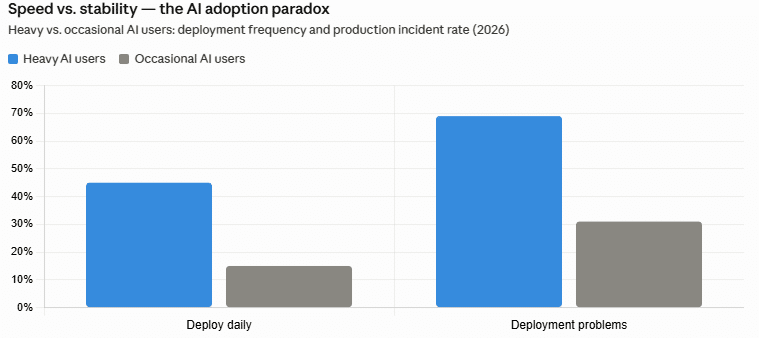
Source: Harness / TechRadar — AI has slashed coding time in 2026, but sacrificed software stability (May 2026)
Before cataloguing the specific scenarios, there is a named failure mode worth understanding: vibe coding.
Vibe coding is the practice of instructing an AI tool to generate code without writing a formal specification first — accepting output that looks plausible, shipping it without rigorous review, and discovering the problems downstream. The name is casual; the consequences are not. It is the primary driver of the 69% deployment failure rate cited above and describes the workflow pattern of most engineers who encounter the failure modes in this guide.
The problem is not that the AI produces bad code. It is the engineer who accepts code they do not fully understand. The moment an engineer commits code they cannot explain line by line, they have transferred accountability to the model — and models are not accountable. They do not understand your architectural constraints, your security requirements, your team conventions, or the business logic that was decided in a meeting six months ago that nobody wrote down.
This is not a rare failure mode. SQ Magazine’s 2026 security analysis found that 56% of developers admit they rarely review AI-generated code line by line — meaning more than half of all AI-generated code in production right now was committed by someone who could not fully explain it.
This guide is the antidote to vibe coding. It is not a list of things AI cannot do. It is a map showing where the cost of accepting AI output without deep understanding exceeds the cost of writing the code yourself.
This is the clearest and most consequential scenario. Authentication logic, authorization rules, cryptography implementations, session management, secrets handling, input sanitization, and access control decisions should not be delegated to AI generation without extraordinary scrutiny — and in most cases should be written by a human engineer who can own every decision.
The 2026 data is striking. Veracode’s Spring 2026 GenAI Code Security Update, testing over 100 large language models, found that 45% of AI-generated code introduces OWASP Top 10 vulnerabilities when no security guidance is explicitly provided in the prompt — and the rate has not improved across multiple testing cycles from 2025 through early 2026 despite vendor claims to the contrary. The per-category numbers are worse still: 86% of AI-generated samples failed to defend against cross-site scripting, and 88% were vulnerable to log injection. These are not edge-case flaws — they are OWASP Top 10 staples.
The Cloud Security Alliance’s April 2026 research across Fortune 50 enterprises found that AI-assisted developers produce commits at 3–4× the rate of their peers but introduce security findings at 10× the rate, creating security debt that accumulates faster than organizations can remediate. SQ Magazine’s 2026 analysis adds that human developers are twice as likely to implement secure authentication flows correctly.
The failure mode has a documented face. In April 2026, Frontend Masters reported a case in which a senior engineer shipped an AI-generated authentication module that passed every test in CI, then caused a production outage two weeks later — the module was using a deprecated OAuth flow that the model had learned from three-year-old Stack Overflow answers. Syntactically perfect. Operationally wrong.
For security code, the correct use of AI is narrow: use it to understand a security pattern, research an approach, or draft an initial structure that you then rewrite with full understanding. Never accept security-critical code from AI without being able to explain — precisely and completely — why every line is correct.
If your software development team is working in regulated domains, the stakes are higher still. Compliance-critical systems in fintech, healthcare, or aerospace carry audit-trail and accountability requirements that AI-generated code cannot meet on its own, regardless of output quality.
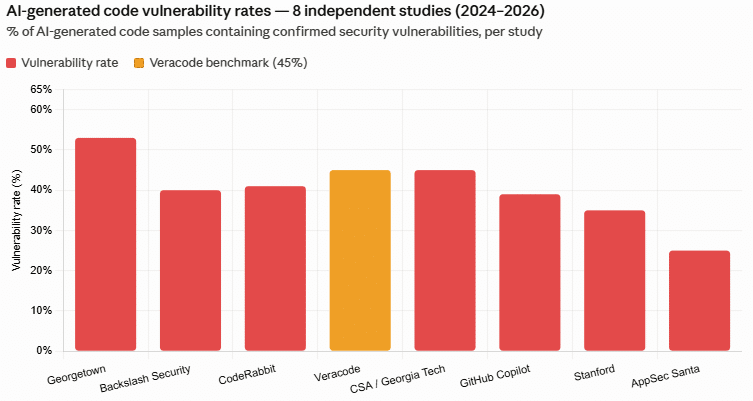
Sources: AI Vyuh Code QA meta-analysis of 8 studies, April 2026 · Veracode Spring 2026 GenAI Code Security Update · Cloud Security Alliance · AppSec Santa 2026
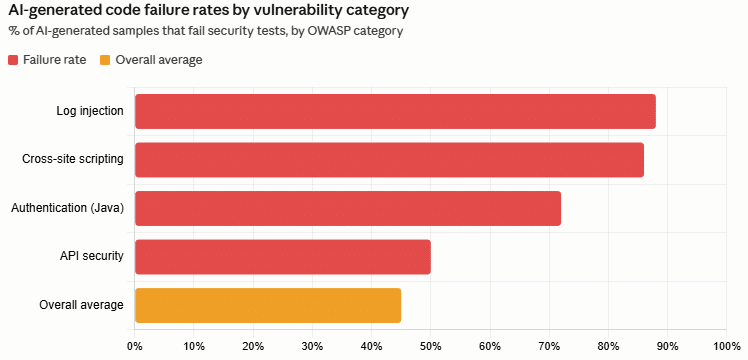
Source: Veracode Spring 2026 GenAI Code Security Update · testing 100+ large language models
One of the clearest moments to avoid AI-generated code or structure is the beginning of messy work — before the problem is actually understood.
Early-stage engineering depends on ambiguity reduction: clarifying what the problem actually is, which constraints matter, which trade-offs are acceptable, and what failure would look like. AI can generate plausible structure at this stage, but that very plausibility makes it dangerous. It gives shape before understanding exists.
When engineers use AI too early, they start optimizing a problem they have guessed at. They accept terminology, architecture, and implementation boundaries that feel coherent but were never earned. The result is a subtle shift from problem framing to solution execution — and the problem framing never happened.
This is particularly costly in product discovery and greenfield architecture work, where the most important output is not code but understanding. Use AI to research approaches, surface options, and explain tradeoffs. Do not use it to generate an implementation until the problem definition is sufficiently solid to write testable acceptance criteria.
System architecture is the domain where AI is most dangerous because the failure mode is invisible until it is expensive.
AI tools generate plausible architectural structures — service boundaries, data models, communication patterns, infrastructure decisions — without any understanding of the business context that makes one structure correct and another wrong. They do not know that your chosen database will become a scaling bottleneck in 18 months when the usage pattern shifts. They do not know that a microservice boundary that looks clean in theory will create an operational nightmare when the on-call rotation is two engineers. They do not know about the business pivot that your leadership discussed last quarter, which changes the whole data ownership model.
As one engineering leader put it in a widely shared 2026 post: AI can give you five ways to scale a database, but it cannot weigh the human cost of maintenance against the financial cost of cloud credits for your specific situation. AI generates structure. It cannot generate sustainable architecture.
Architectural decisions require the kind of contextual judgment that comes from understanding the business, the team, the operational constraints, and the product’s long-term trajectory. AI is a useful thinking partner in this process — surfacing options, explaining tradeoffs, and identifying patterns. It should not be the decision-maker.
Our software engineering teams treat architecture as a human responsibility, always, not because AI cannot generate architectural proposals, but because accepting them uncritically is how teams accumulate expensive technical debt disguised as fast delivery.
When a build fails, a service times out, or a memory spike appears in production, the team does not benefit from fast edits. It benefits from disciplined diagnosis.
AI is tempting for debugging scenarios because it can generate plausible explanations quickly. That speed is the problem. The correct response to a production incident is systematic root cause analysis — forming a hypothesis, testing it against evidence, eliminating alternatives, and understanding the mechanism that caused the failure. AI short-circuits this process by offering convincing explanations that may be subtly wrong.
An engineer who accepts an AI-generated explanation of a production failure and acts on it has patched a symptom, not fixed a cause. The underlying problem remains, often manifesting again under slightly different conditions. The engineer also loses the understanding that comes from working through the diagnosis — the mental model that makes the next incident faster to resolve.
Nobl9’s 2026 analysis of AI-generated code risks documented this pattern precisely: AI-generated code that appears correct and passes basic tests still introduces problems — outdated API use, incomplete error handling, subtle performance regressions, logic drift — that only appear under real-world workloads and manifest as rising P95 latency and increased cloud costs. Debugging these failures requires understanding the original code at a level that is impossible if an AI wrote it and nobody read it carefully.
Use AI to research a technology you are unfamiliar with during debugging. Use it to look up error message patterns or library-specific behaviors. Do not use it to replace the reasoning process of diagnosis. The Quality Engineering Studio approach is clear on this: diagnosis is owned by the engineer, not the tool.
This is the broadest and most important category. If you cannot read AI-generated code and understand every line — what it does, why it does it that way, what it assumes, and what happens when those assumptions are violated — you should not commit it.
This is not a standard that requires engineers to be experts in every technology. It is a standard that requires engineers to understand the code they are responsible for. If you do not understand a piece of AI-generated code, you have two options: study it until you do, or rewrite it yourself. Committing code you cannot explain is not a productivity gain. It is a deferred cost.
This matters especially for:
The back-end development teams at Coderio apply a simple test: if the engineer cannot walk through the code in a review and explain every decision, it does not merge. This applies to human-written code and AI-generated code alike.
AI performs worst in the engineering contexts where it is most tempting: large, undocumented legacy codebases where the business logic is implicit, architectural decisions are unrecorded, and naming conventions reflect choices made by engineers who left years ago.
In these environments, AI generates plausible-looking code that violates unstated conventions, breaks implicit dependencies, and misunderstands the behavioral contracts between components that exist nowhere in writing. The output passes code review because the reviewer also does not fully understand the system, and the failure surfaces in production as an edge case nobody anticipated.
The correct approach to legacy systems is a legacy application migration strategy: document before you modify, understand before you refactor, and test before you change. AI can assist with documentation generation, pattern identification, and test coverage analysis. It should not be used to generate new logic in systems whose behavior is not yet understood.
The most subtle and most important scenario: when the purpose of doing the work is not to produce the output, but to develop understanding.
Junior engineers who use AI to complete tasks they do not yet understand do not learn from those tasks. They learn to prompt AI. The output exists; the mental model does not. Over time, this creates engineers who can generate code but cannot reason about it — who are competent at tooling and incompetent at engineering.
This is not hypothetical. A 2026 survey of developers found that 95% do not fully trust AI to handle mission-critical logic without human review. That distrust is correct — but it requires having the judgment to know what “mission-critical” means in a given context, a judgment that can only be developed by doing difficult work without shortcuts.
Building high-performance engineering teams requires understanding this dynamic. The engineers who produce the most value over their careers are those who use early difficulties to build mental models, not those who work around difficulties with tools. AI is not a shortcut to learning. It is a multiplier for engineers who already know what they are doing.
The seven scenarios above describe specific moments when not to use AI. But there is a downstream consequence that cuts across all of them when the discipline breaks down: silent technical debt.
Silent technical debt is what accumulates when AI-generated code ships at scale without full understanding. It is not the kind of debt that appears as obvious bugs or failing tests. It is subtler: repositories that fill with code nobody can confidently explain, architectural patterns that made sense to the model but not to the business, dependencies that were valid when the model was trained and are now deprecated or vulnerable.
Rootstack’s 2026 engineering analysis names this precisely: when engineers accept auto-generated suggestions without understanding the underlying logic, repositories become filled with “unnecessary abstractions” that require “strict expert-driven code review policies to validate algorithmic performance and maintain repository cleanliness.” The ALM Corp 2026 review of AI in software development frames it as the central governance challenge for the next three years: technical debt that “works today but won’t scale safely.”
The cost compounds. Onboarding slows because the codebase is harder to explain. Debugging slows because the context behind decisions was never written down. Every new feature requires navigating a layer of code that exists but is not understood. The productivity gain from accelerated generation gets consumed — and eventually exceeded — by the friction created by code nobody fully owns.
The antidote is the same in every case: human engineers who understand the code they ship, who can explain every line, and who treat AI as a tool rather than a decision-maker.
Before reaching for an AI coding tool, run through these five questions:
| Question | If “No” → | Action |
|---|---|---|
| Can I fully review and explain this output? | AI usage is risky | Write it manually or study until you can |
| Is this problem well-defined with testable acceptance criteria? | Too early for AI | Define the problem first |
| Is this code outside security, auth, or compliance scope? | Human review required | Write manually; use AI only for research |
| Am I working in a well-documented, understood codebase? | Legacy risk | Document and understand before using AI |
| Is producing this output the goal, not understanding it? | Learning opportunity | Write it manually to build the mental model |
If all five answers are “yes,” AI use is appropriate and likely productive. If any answer is “no,” reconsider — the cost of the shortcut may exceed the cost of the task.
The current debate about AI in software development is too shallow. It often treats adoption as a test of modernity, as though restraint signals resistance. In practice, restraint is frequently a sign of maturity.
The wrong use of AI does not simply create bad output. It creates false confidence, weaker understanding, and expensive cleanup disguised as progress. A poor engineer can use AI to move faster toward the wrong solution. A disciplined engineer can decide that the most valuable act is to slow down, inspect the problem directly, and keep responsibility attached to human judgment. That sounds conservative. It is not. It is operational.
Engineering is not a typing contest. The goal is not the number of lines of code produced per day. The goal is reliable, maintainable systems that do what they are supposed to do under real conditions. AI accelerates code production. It does not substitute for the judgment that makes code production valuable.
This is why development delivery squads structured around senior engineers — not headcount — produce better AI outcomes than larger teams of less experienced developers. The discipline is in the engineer, not the tool. AI amplifies whatever discipline is already present.
When AI use is appropriate, the review practice determines whether it creates value or risk. A responsible review is not a scan for obvious errors. It is a line-by-line reading that answers these questions:
The software testing and QA services framework at Coderio applies the same rigor to AI-generated code as to human-written code — with additional attention to the failure patterns that AI tends to introduce: outdated dependencies, missing edge-case handling, and plausible-but-incorrect logic in domain-specific contexts.
There is a pattern visible across engineering teams in 2026: the engineers with the most experience and the strongest track records are often the most cautious about AI use — not because they distrust the technology, but because they understand the failure modes deeply enough to know when the risk exceeds the benefit.
This is the opposite of the naive framing that treats AI caution as resistance to change. It is a form of expertise. Knowing when not to use AI in software development is a senior skill. Knowing when to use it — and how to review the output — is the practical application of that skill.
The teams that produce the best outcomes with AI in 2026 are not the ones that use it everywhere. They are the ones that use it deliberately: for well-defined tasks with clear acceptance criteria, in documented codebases, reviewed by engineers who can own the output. That discipline is what separates high-performance engineering teams from teams that move fast and break things — including production.
At Coderio, our nearshore engineering teams across Latin America operate with this discipline as the default. IT staff augmentation with senior engineers who understand these constraints is one of the most effective ways to build this practice into a team that is still developing it.
The primary risks are security vulnerabilities in AI-generated code (Veracode’s 2026 testing found that 45% of AI code introduced OWASP Top 10 vulnerabilities), skill erosion among engineers who use AI to bypass learning, and silent technical debt from code shipped without being understood. When AI-generated code fails in production, the consequences are significant: it now causes 1 in 5 enterprise security breaches, with the average AI-related breach costing $4.88 million — the highest on record.
Vibe coding is the practice of asking AI to generate code without a formal specification, accepting output that looks plausible without rigorous review, and shipping it without being able to explain every line. The danger is not that the AI produces obviously wrong code — it is that the code looks correct, often is correct for the common case, but contains edge case failures, security vulnerabilities, or architectural assumptions that only surface under real-world conditions. The engineer who committed the code cannot debug it effectively because they never understood it. More than half of developers (56%) admit they rarely review AI-generated code line by line.
Engineers should avoid or strictly limit AI code generation in seven scenarios: security-critical code (auth, cryptography, access control); early-stage work where the problem is not yet clearly defined; architecture decisions that require business context the AI does not have; debugging and incident diagnosis where systematic reasoning is required; any code they cannot review with full understanding; legacy or undocumented codebases; and any task that is primarily a learning opportunity for the engineer. In all seven cases, the cost of the shortcut exceeds the cost of doing the work properly.
The research and practitioner consensus in 2026 is yes, if used without discipline. Engineers who use AI to complete tasks they do not yet understand develop the ability to prompt AI rather than the ability to reason about code. Over time, they become dependent on tools they cannot evaluate critically, which is the opposite of engineering competence. The correct use of AI for junior engineers is research, exploration, and learning about unfamiliar patterns — not generating code they cannot review with full understanding.
Authentication and authorization logic, cryptographic implementations, security-sensitive input handling, compliance-critical business rules, and any code whose failure mode could expose user data or create a security vulnerability. Additionally, architectural decisions that define system boundaries and long-term tradeoffs, debugging logic for production incidents, and any code in a legacy or undocumented system, where the behavior of the surrounding context is not fully understood.
AI-generated code requires additional scrutiny in specific areas that human engineers rarely get wrong: library import legitimacy and version currency (AI frequently uses deprecated packages from training data), error handling completeness (AI handles common cases, not edge cases specific to your system), implicit assumptions about state or execution context, and alignment between the logic and the actual specification rather than a plausible approximation of it. The review standard is identical — every line must be understood and owned by the reviewer — but the specific risk patterns are different.
Silent technical debt is the accumulated cost of code that was shipped without being fully understood — code that works today but that nobody can confidently explain, maintain, or debug. AI accelerates its creation when engineers accept generated output at scale without line-by-line review. Over time, repositories fill with code whose logic, assumptions, and dependencies are opaque to the team that owns it. Onboarding slows, debugging becomes harder, and every new feature requires navigating undocumented complexity. The only mitigation is the discipline described throughout this guide: human engineers who understand and can own every line they ship.
Knowing when not to use AI in software development is not a constraint on productivity. It is a condition for it. The engineers who understand this are not anti-AI. They are pro-engineering.
The seven scenarios in this guide — security-critical code, early-stage ambiguous problems, architecture decisions, debugging and incident diagnosis, code you cannot fully review, legacy systems, and work that teaches you something — represent the cases where accepting AI output without deep understanding costs more than the time it saves. The silent technical debt that accumulates when those boundaries are ignored is what transforms short-term velocity into long-term drag. Getting these boundaries right is what allows AI to be genuinely productive everywhere else.
The discipline is not in the tool. It is in the engineer. AI amplifies what is already there.
At Coderio, our engineering teams across Latin America are built around this principle: senior engineers who make deliberate decisions about where AI applies and where it does not — and who produce AI-powered software delivery that holds up in production because the judgment behind it is human.
If you are building or scaling a team that needs this discipline embedded from day one, schedule a discovery call so we can walk through what that looks like in your context.