Nov. 17, 2025

19 minutes read
Share this article
Security teams are drowning in signal. A modern security operations center can generate tens of thousands of alerts a day across firewalls, endpoints, identity systems, and cloud workloads, and only a fraction of them matter. When the average cost of a data breach reached $4.88 million in 2024, the highest figure on record and a 10 percent jump over the prior year according to IBM, the gap between how fast attackers move and how fast defenders respond became a board-level financial problem, not just a technical one.
Security orchestration and automation is the discipline that closes that gap. Rather than asking analysts to click through the same investigation steps a hundred times a day, a SOAR platform connects the tools a security team already owns, codifies the response into repeatable playbooks, and executes routine actions in seconds. The same IBM research found that organizations using security AI and automation extensively across prevention workflows spent $2.2 million less per breach than organizations that used none, the single largest cost saving in the report. This guide explains what SOAR is, how it works end-to-end, where it delivers the most value, which platforms lead the market, and how to roll it out without creating new problems.
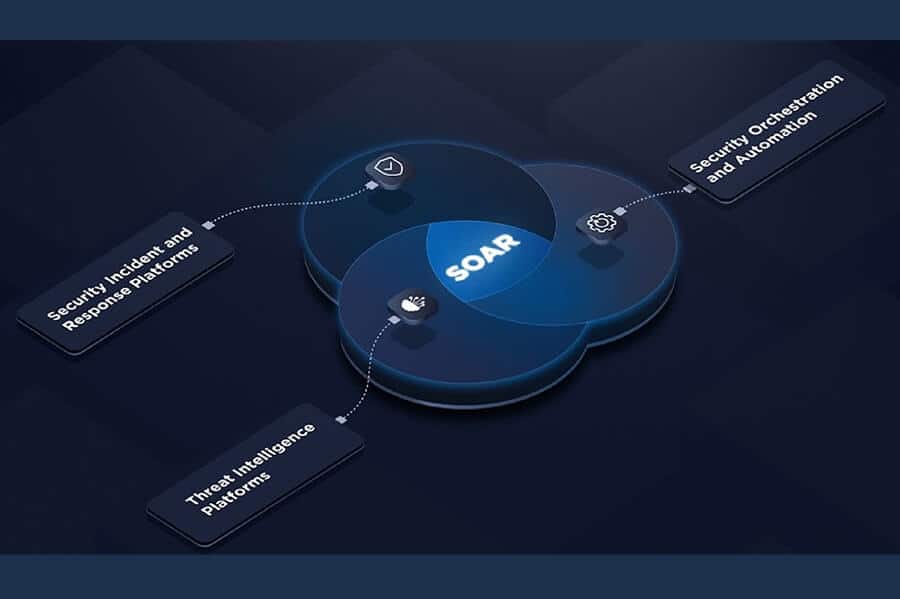
SOAR stands for security orchestration, automation, and response. Analyst firm Gartner introduced the term to describe technologies that let organizations collect security data and alerts from disparate sources and then define, prioritize, and drive standardized incident response activities according to a workflow. In plain terms, a SOAR platform is the connective tissue and the decision engine that sits above your existing security stack. It does not detect threats on its own so much as it coordinates every tool that does, and it turns human runbooks into software.
That distinction matters. Companies sometimes buy a SOAR platform expecting it to replace detection tools, then feel disappointed. SOAR is force multiplication for the tools and people you already have. IBM describes it as a way to bring centralized management to security operations, and that framing is the right mental model.
The acronym maps to three distinct capabilities that work together:
Buyers frequently confuse these categories because vendors blur the lines. A SIEM (security information and event management) ingests and correlates log data to raise alerts. XDR (extended detection and response) unifies detection and response inside a single vendor ecosystem. The SOC is the team and function that operates all of it. SOAR is the layer that orchestrates action across whatever you run. The table below summarizes the practical differences.
| Capability | SIEM | SOAR | XDR |
|---|---|---|---|
| Primary role | Collects and correlates log data to surface alerts | Coordinates tools and automates the response to those alerts | Detects and responds across endpoints, network, and cloud from one vendor stack |
| Core output | Detections and dashboards | Playbooks, case management, automated actions | Unified detections with built-in response |
| Human effort | High: analysts triage every alert | Low to medium: routine steps run automatically | Medium: guided response inside the platform |
| Integration scope | Broad data ingestion | Broad, vendor-neutral action layer across many tools | Deep within one vendor ecosystem |
| Best when | You need visibility and compliance logging | You run many tools and want to codify response | You want turnkey detection and response in one suite |
In most mature environments, these categories coexist. A SIEM or XDR platform surfaces the alert, threat intelligence enriches it, and SOAR decides what happens next and makes it happen. Treating them as competitors rather than layers is a common and expensive mistake.
SOAR did not emerge from a vendor marketing meeting. It emerged because the traditional model of throwing more analysts at more alerts stopped scaling. Three pressures made automation unavoidable.
The volume problem is structural. Every new tool a security team adds produces its own stream of alerts, and a large share are false positives or low-priority noise. Analysts cannot investigate everything, so they triage, and under pressure they miss things. Alert fatigue is not a discipline problem; it is a math problem: when a person faces more events than they can meaningfully review, quality degrades no matter how skilled they are. Orchestration platforms attack this at the source by filtering, deduplicating, and correlating events before a human ever sees them, so analysts can focus on the incidents that carry real risk.
There are not enough security professionals to close the gap with headcount. The ISC2 Cybersecurity Workforce Study has documented a global shortfall of millions of practitioners, with workforce growth stalling even as threats climb. IBM quantified the operational cost of that shortage directly: organizations with severe staffing shortages incurred $1.76 million in higher breach costs than those without, and the share of organizations reporting severe shortages rose 26 percent year over year. Automation is the only realistic lever that lets a fixed team cover a growing surface.
Time is the variable that turns an intrusion into a breach. The longer an attacker dwells, the more data they exfiltrate and the more the cleanup costs. IBM found the global average breach lifecycle fell to a seven-year low of 258 days in 2024, and, critically, organizations that deployed security AI and automation extensively identified and contained breaches 98 days faster than those that did not. Faster containment is not a vanity metric. It maps directly to lower cost, less regulatory exposure, and less operational disruption. This is the core business case for SOAR, and it is why security investment decisions increasingly start with response speed rather than tool count.
Speed also compounds. Faster containment reduces the window for lateral movement and data theft, which in turn shrinks the scope of regulatory notification, legal exposure, and customer notification obligations that follow a serious breach. A response measured in hours instead of days can be the difference between a contained incident and a reportable event. That is why leadership teams now treat MTTR as a risk metric with a dollar value attached, and why orchestration and automation have moved onto the board agenda rather than staying buried in the security team’s backlog.
Understanding the mechanics helps set realistic expectations. A SOAR deployment has three working parts that correspond to the three pillars, plus the human judgment that governs them.
Everything starts with integration. A SOAR platform ships with prebuilt connectors, often several hundred, for common security and IT tools, and exposes a framework for building custom ones against any product with an API. This layer is where orchestration lives. When an alert arrives, the platform can query threat intelligence, pull user context from the identity provider, check the asset inventory, and issue a containment command to the endpoint agent, all through these connectors. The breadth and quality of the connector catalog is one of the most important selection criteria, because a playbook is only as capable as the integrations beneath it. Teams that treat API integration as an afterthought discover their automation stalls at the first tool that does not talk to the platform.
A playbook is the executable version of the runbook a senior analyst keeps in their head. It is a workflow, often built in a visual, low-code editor, that defines the sequence of conditions and actions for a given incident type. A phishing playbook, for example, might extract URLs and attachments from a reported email, detonate them in a sandbox, check senders against reputation feeds, search the mail environment for other copies, and quarantine every match, pausing for analyst approval only before the irreversible steps. Well-designed playbooks resemble good software: modular, versioned, tested, and reused across incident types. Tools like Ansible are often part of the underlying automation fabric that playbooks call into for infrastructure-level actions.
Automation without governance is dangerous, so mature SOAR platforms center on case management. Every incident becomes a case that aggregates the triggering alert, enriched context, the actions taken, and analyst decisions in one timeline. This does three things: it gives responders a single pane to work from, it preserves an auditable trail for compliance and compliance testing, and it keeps humans in control of consequential decisions. The design principle to follow is simple. Automate the reversible and the repetitive, and require human approval for the destructive and the ambiguous. Isolating a laptop can be automatic. Wiping it should not be.
A useful rule of thumb: automate the steps whose outcome you can predict and undo, and keep a human in the loop for any action that is hard to reverse or that a clever attacker could weaponize against you.
SOAR pays off fastest on high volume, well-understood incident types. These four are where most teams start.
Phishing is the highest volume use case for most organizations, and it is nearly ideal for automation because the investigation steps are consistent. A phishing playbook parses the reported message, extracts and detonates indicators, correlates them against threat intelligence, searches every mailbox for the same message, and quarantines matches. What took an analyst twenty minutes of manual clicking per report happens in under a minute, and the response scales linearly with reports rather than with headcount. A representative phishing playbook runs roughly as follows:
Only steps that are hard to reverse, such as a bulk quarantine across thousands of mailboxes, need an approval gate. Everything else runs unattended, which is why phishing response is the use case most teams automate first and trust soonest.
Enrichment is the connective work that precedes almost every decision: is this IP known bad, has this hash been seen before, who owns this asset, is this user privileged. Doing it by hand is slow and inconsistent. A SOAR platform gathers this context automatically the moment an alert fires and presents a decision-ready summary, so the analyst starts from an informed position instead of a blank screen. Feeding high-quality data sources into this layer is what separates useful enrichment from noise.
When an endpoint shows signs of compromise, speed of isolation determines blast radius. An orchestration playbook can automatically isolate the host from the network, capture forensic evidence, disable the associated user account, and notify the responder, in the seconds it takes an attacker to attempt lateral movement. Because these actions are reversible and the trigger is high confidence, containment is one of the safest steps to fully automate.
Beyond active incidents, SOAR streamlines operational security work. It can ingest vulnerability scan results, correlate them with asset criticality and threat intelligence, and open prioritized remediation tickets automatically so the most dangerous exposures reach owners first. On the identity side, playbooks handle suspicious login responses, access reviews, and offboarding. These workflows pair naturally with a zero trust security model, where continuous verification generates exactly the kind of signals that automated response is built to handle.
The market has consolidated around a handful of platforms, most now bundled into broader security operations suites. The right choice depends far more on your existing stack and team maturity than on feature checklists.
Four platforms account for most enterprise deployments:
Automation handles the deterministic work. Machine learning handles the probabilistic work: scoring alerts by likely severity, clustering related events into a single incident, spotting anomalies that no static rule anticipated, and increasingly, using large language models to summarize an incident or draft a response recommendation. IBM found that two out of three organizations are now deploying security AI and automation across the SOC. The emerging frontier is agentic AI, where systems reason across steps and take multi-stage action, which raises the governance stakes considerably. Teams exploring this should first understand the risks of AI in security and apply the same human oversight discipline that governs any consequential automation. Building this capability well often calls for dedicated machine learning and AI expertise. The practical guidance is to let AI advise and prioritize while automation and humans decide and act. A model that ranks alerts or clusters events well is enormously useful and low risk. A model that autonomously takes destructive action is a different proposition, and the maturity of your monitoring, logging, and rollback capability should govern how far you let it run without a human check.
Almost no organization should build a SOAR platform from scratch. The engineering cost of maintaining hundreds of integrations dwarfs any licensing saving. The real build-versus-buy decision happens one level down, in playbook development and custom connectors, where in-house work is often justified because your response process is specific to your environment. A pragmatic approach buys the platform and invests engineering effort in the playbooks and integrations that encode your unique operational knowledge.
For teams without the staff to run a platform themselves, managed detection and response and managed SOAR services offer a third path. A provider operates the orchestration layer and the playbooks on your behalf, which lowers the barrier to entry and puts automation in reach of organizations that could never staff a full SOC. The tradeoff is less direct control and a dependence on the provider’s playbook quality, so the same diligence you would apply to any critical vendor applies here: understand what is automated, what stays under human control, and how incidents are escalated back to you.
SOAR programs succeed or fail on measurement, and the two headline metrics are mean time to detect (MTTD) and mean time to respond (MTTR). Automating enrichment and containment compresses both, because the platform performs in seconds what a queue of analysts performed in minutes or hours. Secondary metrics tell the operational story: the percentage of alerts handled without human touch, analyst hours returned to higher value work, dwell time before containment, and the consistency of response measured by how often playbook steps are followed. The NIST computer security incident handling guidance, NIST SP 800-61, is a useful reference for structuring these measurements against a recognized incident response lifecycle.
Vendor case studies advertise dramatic reductions in response time and alert volume, and mature deployments do achieve large gains on automated incident types. Treat those figures as directional rather than guaranteed. Actual results depend on how many of your incidents are automatable, how clean your integrations are, and how disciplined your playbook design is. A realistic first-year target is meaningful automation of your two or three highest-volume incident types, measurable MTTR reduction on those types, and a demonstrable return of analyst time. The verified financial anchor to hold onto is IBM’s finding that extensive use of security AI and automation correlated with $2.2 million lower breach costs and containment 98 days faster. That is the outcome the metrics are ultimately proxies for.
A SOAR rollout fails when teams try to automate everything at once. It succeeds as a phased program. The five steps below reflect how experienced teams sequence the work.
The failure modes are predictable. Overautomating too early erodes trust the first time a bad playbook takes a wrong action. Underinvesting in playbook maintenance lets automation rot as tools and threats change. Poor integration hygiene leaves brittle connections that break silently. And treating SOAR as a purely technical project, rather than a change to how the SOC works, guarantees weak adoption. Many of these mirror the broader pitfalls of AI and automation adoption, and the same governance mindset that keeps AI and machine learning aligned with zero trust applies here.
A SIEM collects and correlates log data to detect and surface alerts. SOAR takes those alerts and coordinates the response, automating investigation steps and executing containment across your tools. A SIEM tells you something happened. SOAR decides what to do about it and does it. Most mature security operations run both, with the SIEM feeding alerts into SOAR playbooks.
No. SOAR removes the repetitive, low-judgment work so analysts can focus on investigation, threat hunting, and the decisions that genuinely require human expertise. It is a force multiplier for a team, especially valuable given the ongoing shortage of security professionals. The best deployments keep humans in control of consequential actions and let automation handle the routine steps.
A first useful playbook can go live within a few weeks if the target use case is well understood and the required integrations exist. A broad, mature program that covers most major incident types typically takes several months to a year, because the work is iterative: integrate, automate one use case, measure, refine, and expand. Treating it as a phased program rather than a single deployment is the key to success.
Not anymore. SOAR began as an enterprise technology, but managed security service providers and cloud native platforms have brought orchestration and automation within reach of mid-sized organizations. Any team facing more alerts than it can handle manually, which is most teams, can benefit. The right entry point for a smaller organization is often a managed service or the automation built into an existing security platform.
Traditional SOAR automates deterministic, rule-based steps. AI and machine learning add probabilistic capability: smarter alert prioritization, anomaly detection, event correlation, and language models that summarize incidents and recommend responses. Agentic AI, which can reason across steps and act, is the emerging frontier and raises the importance of strong human oversight and governance. AI makes SOAR more capable, but it does not remove the need for accountable human control.
Security orchestration and automation has moved from a nice-to-have to a structural necessity. The volume of alerts, the shortage of skilled defenders, and the direct financial cost of slow response have made the old model of manual triage untenable. The evidence is unambiguous: IBM’s research ties extensive use of security automation to $2.2 million in lower breach costs and containment 98 days faster than organizations that go without. SOAR delivers that by connecting the tools you already own, codifying your response into tested playbooks, and executing the routine work in seconds while keeping humans in control of the decisions that matter.
The organizations that get the most from SOAR treat it as a program rather than a product. They start with one high-value use case, integrate deliberately, keep humans in the loop until automation earns trust, and measure everything. Done that way, orchestration and automation do not just make a security team faster. They make it more consistent, more resilient, and able to cover a growing threat surface without a matching growth in headcount. If you are weighing where to begin, a focused security assessment and a clear view of your highest volume incident types are the right first steps, and a dedicated digital security team can help you build the roadmap.
The Complete Guide to Compliance Testing
Zero Trust Security: A Practical Guide
AI Security Risks Every Team Should Understand
How to Correctly Apply AI and ML in a Zero Trust Architecture
Diego Ceballos is CISO at Coderio, with more than 20 years of experience in cybersecurity, auditing, and data protection. Throughout his career, he has specialized in aligning the technical robustness of IT architecture with business objectives; going beyond implementing controls to designing governance strategies, ensuring compliance with complex regulatory frameworks, and optimizing internal audit processes. His focus is on protecting a company's most valuable asset — its information — while keeping operations efficient and secure in a constantly evolving digital ecosystem. As CISO, he oversees Coderio's security posture across its own operations and its client engagements, and writes about emerging security challenges including compliance architecture for regulated industries, post-quantum cryptography, and enterprise risk mitigation.
Diego Ceballos is CISO at Coderio, with more than 20 years of experience in cybersecurity, auditing, and data protection. Throughout his career, he has specialized in aligning the technical robustness of IT architecture with business objectives; going beyond implementing controls to designing governance strategies, ensuring compliance with complex regulatory frameworks, and optimizing internal audit processes. His focus is on protecting a company's most valuable asset — its information — while keeping operations efficient and secure in a constantly evolving digital ecosystem. As CISO, he oversees Coderio's security posture across its own operations and its client engagements, and writes about emerging security challenges including compliance architecture for regulated industries, post-quantum cryptography, and enterprise risk mitigation.
Accelerate your software development with our on-demand nearshore engineering teams.