

Last Updated January 2026
Companies continue to look for practical ways to expand engineering capacity, accelerate delivery, and control software development costs. In that context,Latin America software outsourcing has become a relevant option for organizations seeking access to qualified talent without the communication friction often associated with distant offshore models.
For businesses seeking to outsource software developers in Latin America, the region offers a combination of overlapping time zones, established technology hubs, competitive rates, and teams accustomed to working with U.S. and global companies. At the same time, nearshore software development in Latin America gives organizations a way to scale with greater day-to-day collaboration, which is often essential for agile delivery, product iteration, and long-term roadmap execution.
Whether the goal is to launch an MVP, modernize an existing platform, or extend an in-house team, Latin America has become a consistent choice for software development partnerships. The reasons behind that shift are practical rather than theoretical: access to talent, operational flexibility, and a delivery model that supports closer coordination.
The growing interest in Latin America software outsourcing reflects a broader change in how companies build digital products. Instead of limiting hiring to local markets, many organizations now evaluate regional talent models that provide a better balance between cost, quality, and delivery speed.
Latin America stands out because it serves both outsourcing and nearshore needs. Businesses can engage dedicated development teams, IT staff augmentation, or managed delivery services while still maintaining stronger communication rhythms than they often achieve with traditional offshore arrangements. That makes the region especially relevant for companies that need flexibility without sacrificing visibility.
Software development outsourcing has expanded as companies face stronger competition for engineering talent and tighter budget pressures. In response, Latin America has gained attention as a region capable of supporting product development through skilled engineers across web, mobile, cloud, QA, DevOps, and data-related disciplines.
This increase in demand is not driven by cost alone. Many organizations are looking for partners that can integrate into daily workflows, contribute to faster decision-making, and support continuous collaboration. That is where Latin America has strengthened its position. The region is frequently discussed in the market as a nearshore alternative for U.S. companies because working hours overlap more closely than with providers in Asia or Eastern Europe.
Companies are no longer treating outsourcing strictly as a back-office cost-saving tactic. It is increasingly used to access specialized engineering capacity, reduce hiring bottlenecks, and accelerate releases. Latin America fits that model because it can support both short-term team extension and broader software delivery initiatives.
One of the region’s main advantages is that it offers a middle ground between onshore and offshore pricing. Rates are typically lower than those in the United States or Western Europe, while collaboration conditions are often easier than with more distant outsourcing destinations. That cost-quality balance is one reason many companies choose to outsource software development in the region rather than rely only on domestic hiring.
For many North American companies, the strongest case for the region is not just outsourcing in general, but specifically Latin America nearshore software development. Nearshoring refers to outsourcing services to a geographically closer country, which helps reduce time-zone gaps and supports more direct collaboration. That distinction matters because software delivery often depends on fast feedback cycles and shared working hours.
Nearshore software development is a sourcing model in which a company works with teams in nearby countries instead of relying on domestic hiring or distant offshore providers. In practical terms, the model is designed to make meetings, sprint planning, issue resolution, and product discussions easier to coordinate across teams.
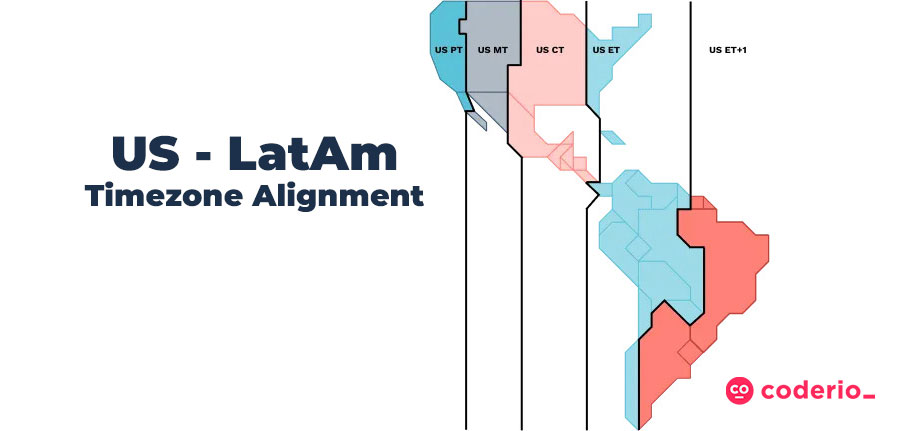
For companies in the United States, Latin America is a common nearshore region because many countries operate within one to four hours of U.S. time zones. That creates a more workable environment for real-time communication and shared accountability.
Time zone compatibility is one of the clearest strengths of the region. Teams can attend standups, planning sessions, technical reviews, and stakeholder meetings without the delays that often affect offshore arrangements. The practical impact is not only convenience. It can also improve project momentum, reduce handoff gaps, and support faster issue resolution.
Geographic proximity also makes travel simpler when in-person workshops, onboarding sessions, or executive meetings are necessary. For companies that value periodic face-to-face alignment, Latin America is easier to access than many other outsourcing destinations.
A major reason companies pursue Latin America software outsourcing is the depth of the region’s engineering talent. Countries such as Mexico, Argentina, Brazil, and Colombia are regularly cited as leading sources of software developers, supported by local universities, startup ecosystems, and growing participation in global digital services.
The talent base also spans a broad range of technologies. Across the region, companies can find engineers working with JavaScript frameworks, back-end platforms, cloud services, mobile development tools, QA automation, and modern DevOps practices. Many teams also have experience working in English-language delivery environments, which further supports cross-border collaboration.
The pressure to find qualified developers has pushed more companies to evaluate regional sourcing strategies. Latin America appeals to these organizations because it supports a combination of speed, quality, and communication continuity that is difficult to achieve through local hiring alone.
As software initiatives expand, internal recruitment often becomes slower and more expensive. Latin American teams help address that challenge by giving companies access to developers who can be integrated into active projects more quickly than traditional domestic hiring processes often allow.
Nearshore delivery can create a practical operational advantage. Faster communication, easier planning, and closer collaboration can reduce friction across product, engineering, and business teams. For companies that depend on quick iteration, these factors are often as important as rate differentials.
The choice between nearshore and offshore outsourcing is not always about which model is universally better. It depends on the project, communication requirements, budget structure, and expected management overhead.
Offshore software development models may offer lower headline costs and access to large talent pools. However, they can also introduce wider time-zone gaps, more communication delays, and greater cultural or workflow differences, especially for projects that require frequent collaboration.
Nearshore development in Latin America generally offers:
The tradeoff is that rates may be somewhat higher than in some traditional offshore markets. Even so, many organizations consider the additional collaboration value worth that difference.
| Factor | Nearshore (Latin America) | Offshore (Asia/Eastern Europe) |
|---|---|---|
| Time zone overlap with U.S. | 0–4 hours | 8–13 hours |
| Real-time collaboration | ✅ High | ⚠️ Limited |
| Cultural alignment (U.S.) | ✅ Strong | ⚠️ Variable |
| Hourly rate | $$ Mid | $ Low |
| Management overhead | Lower | Higher |
| Travel accessibility | ✅ Easy | ❌ Costly |
Offshore can be appropriate for asynchronous tasks with stable requirements. But for agile delivery, product iteration, and cross-functional collaboration, Latin America nearshore development consistently delivers better outcomes.
Cost efficiency in software outsourcing should not be reduced to hourly rates alone. The more relevant measure is the relationship between cost and delivery effectiveness. A lower-cost team that creates delays, rework, or communication overhead can be less efficient than a moderately priced team that integrates well with product goals.
That is why many companies view Latin America as a practical option. The region can reduce labor costs compared with U.S. hiring while still supporting real-time teamwork, faster feedback, and stable engineering output. In that sense, the value of Latin America software outsourcing comes from overall execution efficiency, not just payroll savings.
Cultural compatibility is often underestimated in software delivery. Shared expectations around communication, responsiveness, collaboration, and ownership can make a material difference in project outcomes. Latin American teams are frequently described as easier for U.S. organizations to work with on a day-to-day basis because of closer business norms and communication styles.
That alignment can help reduce misunderstandings, improve teamwork across distributed squads, and support stronger long-term partnerships.
Remote software delivery is now a standard operating model for many companies, and Latin American engineers are well-positioned for that environment. Teams across the region work through modern collaboration tools, agile processes, and distributed development practices that allow them to contribute effectively to cross-border product organizations.
For companies that want flexibility in how they build teams, this matters. They can engage developers remotely, scale gradually, and maintain access to a broad talent pool without the constraints of one local market.
Choosing the right partner is as important as choosing the right region. A strong outsourcing or nearshore relationship depends on more than availability.
Although the region offers meaningful advantages, companies should still plan for common outsourcing risks. These may include variation in English proficiency, differences in local market conditions, and the need for clearer onboarding when teams are distributed across countries.
Best practices usually include:
These practices help turn a promising sourcing decision into a durable working model.
Latin America offers the strongest combination of time zone overlap, qualified engineering talent, cultural alignment with U.S. business norms, and competitive rates of any outsourcing region for North American companies. It supports both nearshore collaboration and full-scale outsourcing models.
Argentina, Brazil, Colombia, and Mexico are consistently the top four. Each has a distinct profile — Argentina for engineering depth, Brazil for scale, Colombia for growing bilingual talent, and Mexico for proximity to the U.S.
Rates vary by country, seniority, and engagement model but are typically 40–60% below comparable U.S. talent costs. The more relevant measure is total delivery cost, including communication efficiency and rework rates.
Nearshore refers to outsourcing to geographically close regions (for U.S. companies, Latin America), while offshore typically refers to more distant regions like Asia or Eastern Europe. Nearshore offers better time zone alignment and real-time collaboration; offshore may offer lower baseline rates but typically higher coordination costs.
Latin America has become a strong option for companies that need qualified engineering support with better collaboration conditions than many offshore models can provide. For organizations looking to outsource software developers in Latin America, the region offers a practical mix of skilled talent, competitive costs, overlapping work hours, and operational flexibility.
At the same time, Latin America’s nearshore software development has grown in relevance because it supports real-time communication and closer integration with in-house teams when combined with the broader advantages of Latin America software outsourcing, which makes the region a logical choice for companies that want to scale software delivery without creating unnecessary coordination barriers. kickoffs easier. The matching time zones help teams work together better, making the project flow smoothly.
Ready to explore your options?
Schedule a call with Coderio to discuss how a Latin American nearshore team can accelerate your roadmap.