
Last Updated January 2026
The way businesses build and run applications is shifting fast. Traditional server management is giving way to a model where code runs only when it needs to, infrastructure scales itself, and teams pay exclusively for the compute they consume. That model has a name: Function-as-a-Service (FaaS), the execution layer at the heart of serverless architecture.
This guide combines everything you need to know — what FaaS is, why it matters financially, how it compares to older cloud models, which platforms to consider, and how to adopt it safely.
$36B+ Global serverless market size projected by 2028 (CAGR ~24%)
Function-as-a-Service is a cloud execution model in which developers deploy small, discrete units of logic (functions) that run in response to specific events. Instead of renting a server and keeping it running around the clock, you write a function, upload it to a platform like AWS Lambda, and pay only for the milliseconds it runs when triggered.
The term “serverless” can be misleading: servers still exist, but managing them is entirely the cloud provider’s responsibility. Your team focuses on code, not infrastructure. This is the fundamental proposition that makes FaaS attractive to businesses of all sizes.
Key Definition
FaaS is the compute layer of serverless architecture. Every FaaS deployment is serverless, but not every serverless service is FaaS (managed databases, for instance, are also serverless).
Understanding FaaS requires a quick look at its origins. Each generation of cloud computing has reduced the operational burden on development teams.
| Model | You Manage | Provider Manages | Billing Unit | Best For |
|---|---|---|---|---|
| IaaS (e.g., EC2) | OS, runtime, app, scaling | Physical hardware, network | Per hour (running or not) | Full control needs |
| PaaS (e.g., Heroku) | App code, data | OS, runtime, scaling | Per instance / per hour | Web apps, APIs |
| FaaS / Serverless | Function code only | Everything else | Per execution (ms precision) | Event-driven, microservices |
The progression is clear: each step removes another layer of operational overhead, culminating in FaaS, where you interact with the cloud purely through code and events. This shift also aligns billing with actual business activity rather than reserved capacity, a change that has significant financial implications.
50% Infrastructure cost reduction reported by early FaaS adopters like Netflix
Traditional cloud models charge for servers whether they are handling requests or sitting idle. FaaS eliminates that waste entirely. AWS Lambda, for example, bills in 1-millisecond increments and provides 1 million free requests per month. Companies like Netflix and Airbnb have reported infrastructure cost savings in the range of 30 to 50 percent after migrating event-driven workloads to serverless platforms.
FaaS platforms scale functions horizontally and automatically in response to traffic. An e-commerce site that normally handles 1,000 requests per minute but spikes to 100,000 during a flash sale does not require manual server provisioning or a 3 a.m. incident response. The platform absorbs the surge and scales back down when the sale ends, all without intervention.
By eliminating server setup, configuration management, and capacity planning, FaaS can compress development cycles considerably. Teams building with cloud-native architectures report bringing new features from code to production in days rather than weeks. The focus shifts entirely to writing business logic.
When developers are freed from managing infrastructure, they concentrate on solving problems and improving products. Platforms like OpenFaaS and the major cloud offerings all provide pre-built runtime environments, monitoring dashboards, and deployment pipelines that further accelerate day-to-day work.
Four properties define how FaaS platforms operate, and understanding them shapes how you design applications for this model.
Functions are dormant until an event triggers them. Triggers include HTTP requests, file uploads to object storage, database changes, scheduled cron jobs, queue messages, and IoT sensor data. Because code only runs when something happens, compute is never wasted.
Each function invocation is independent. A function cannot rely on memory from a previous run. Persistent data must live in an external store such as a database, object storage, or a cache like Redis. This constraint is a design discipline that makes functions more portable, testable, and resilient.
The platform creates as many concurrent function instances as needed and distributes them across availability zones. There is no capacity to plan, no Auto Scaling Group to configure, and no on-call rotation for capacity events. The platform handles failover between zones transparently.
Billing reflects actual invocations and duration rather than reserved time. For workloads with irregular or bursty traffic patterns, this can produce dramatic savings compared to always-on infrastructure.
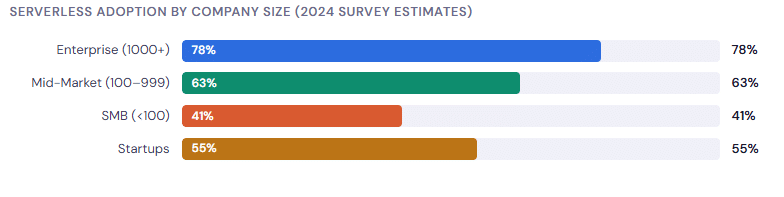
70% of enterprises using public cloud have deployed at least one serverless function
Several mature platforms cover the majority of enterprise FaaS workloads. Choosing among them depends on your existing cloud footprint, language preferences, integration requirements, and tolerance for vendor coupling.
| Feature | AWS Lambda | Azure Functions | Google Cloud Functions |
|---|---|---|---|
| Max execution time | 15 minutes | Unlimited (Premium) | 60 minutes (2nd gen) |
| Cold start mitigation | Provisioned concurrency | Premium plan, Always-on | Min instances (2nd gen) |
| Free tier (requests/month) | 1 million | 1 million | 2 million |
| Stateful workflows | Yes (Step Functions) | Yes (Durable Functions) | Limited (Workflows) |
| Hybrid / on-prem support | Via Outposts | Strong | Limited |
| Ecosystem maturity | Highest | High | High |
FaaS delivers the most value for workloads that are event-triggered, traffic-variable, or composed of many loosely coupled steps. Here are the patterns that appear most consistently in production deployments.
3x Faster average time-to-market for new features compared to traditional deployments

One of serverless architecture’s less-discussed advantages is how well it fits modern DevOps and CI/CD workflows. The concept of NoOps — eliminating operational overhead entirely — is an aspiration that FaaS moves closer to reality.
Because functions are small, independently deployable units, teams can release individual features without coordinating a full application deployment. A bug fix to a single endpoint means deploying one function, not a monolith. This fundamentally changes the release cadence: deployments become low-risk, frequent, and incremental.
Serverless platforms integrate with standard CI/CD pipelines. Tools like the Serverless Framework, AWS SAM, and Terraform all support function-based deployment workflows that fit naturally into existing DevOps practices. Monitoring is also well-supported, with AWS CloudWatch, Azure Monitor, and Google Cloud Logging providing function-level metrics and distributed tracing out of the box.
DevOps Tip
Pair FaaS with message queues (AWS SQS, Azure Service Bus) for asynchronous decoupling between services. This pattern isolates failure, smooths traffic bursts, and makes each function easier to test in isolation.
Security hesitation is one of the most common reasons teams delay serverless adoption, and much of it stems from a misunderstanding of how FaaS environments work.
Each function invocation runs in its own isolated, ephemeral container managed by the cloud provider. This isolation means a vulnerability in one function does not automatically expose others. The attack surface is also smaller: there are no operating systems to patch, no SSH ports to harden, and no persistent servers to compromise.
That said, serverless introduces its own security considerations:
| Risk Area | Mitigation |
|---|---|
| Over-privileged functions | Apply least-privilege IAM roles to every function; grant only the permissions it needs |
| Secrets in environment variables | Store credentials in AWS Secrets Manager or HashiCorp Vault, never in plain env vars |
| Injection attacks via event data | Validate and sanitize all inputs before processing, regardless of the trigger source |
| Dependency vulnerabilities | Audit third-party packages with tools like Snyk or Dependabot before bundling them |
| Insufficient logging | Enable CloudTrail / Cloud Audit Logs and set up alerts for anomalous invocation patterns |
Cloud providers, including AWS, Azure, and Google Cloud, invest heavily in platform-level security that often surpasses what organizations can achieve in self-managed data centers. Serverless shifts the security responsibility from infrastructure hardening to function-level access control and input validation.
Serverless is not the right answer for every workload. Being honest about the limitations helps teams avoid costly mismatches between the architecture and the problem.
When a function has not been invoked recently, the platform must initialize a new container before executing it. This “cold start” adds latency that can be significant for user-facing, latency-sensitive applications. AWS Provisioned Concurrency and Azure’s Premium plan both address this by keeping function instances warm, but at an additional cost.
AWS Lambda caps functions at 15 minutes per invocation. Azure Functions’ consumption plan has similar limits, though the Premium plan removes them. Long-running processes such as video encoding jobs or complex machine learning inference pipelines need alternative approaches or must be broken into chained functions using orchestration tools like Step Functions.
FaaS platforms expose proprietary trigger mechanisms, integrations, and configuration APIs. A function written tightly against AWS Lambda’s ecosystem requires significant rework to move to Azure Functions. The Serverless Framework and open standards like CloudEvents help, but total portability remains elusive.
Debugging a serverless application differs fundamentally from debugging a monolith. Logs are distributed across many ephemeral containers, and tracing a single request across multiple chained functions requires deliberate instrumentation. Tools like AWS X-Ray, Datadog, and Lumigo are purpose-built for this, but the learning curve is real.
Watch Out
FaaS can be more expensive than always-on compute for workloads with consistently high, sustained traffic. Model your invocation patterns and run a cost comparison before committing to serverless for high-throughput, low-latency services.
Store all session data, user state, and intermediate results in external services. Amazon DynamoDB, Redis, or S3 are common choices. Functions that assume state from a previous invocation will fail intermittently and unpredictably.
Each function should do one thing well. Large, multi-responsibility functions are harder to test, deploy independently, and scale efficiently. Treat each function like a microservice: it has a clear contract, minimal dependencies, and a single reason to change.
Include only the libraries your function actually needs in the deployment package. Use Lambda Layers or similar mechanisms to share dependencies. Initialize heavy objects (database connections, SDK clients) outside the function handler so they are reused across warm invocations. For critical user-facing paths, use provisioned concurrency.
Apply the principle of least privilege to every IAM role. A function that reads from S3 should not also have permission to write to DynamoDB. Treat each function’s permissions as a separate security boundary.
Long multi-step processes (order fulfillment, document processing pipelines) should be modeled as state machines using AWS Step Functions, Azure Durable Functions, or a workflow engine like Temporal. Avoid chaining functions with direct invocations, which creates tight coupling and makes error handling brittle.
Enable distributed tracing before going to production. Set up alarms on error rates, duration percentiles, and throttling events. The visibility you establish early will save hours of debugging later.
Migration Approach
Start by moving background jobs, scheduled tasks, and webhook handlers to FaaS. These workloads are naturally event-driven, tolerate occasional cold starts, and provide low-risk proof of concept before tackling customer-facing APIs.
Serverless architecture is not universally superior, but it is the right default choice for a growing list of common workloads. The decision framework below helps teams identify where it fits.
| Your Situation | Serverless Fit | Reasoning |
|---|---|---|
| Bursty, unpredictable traffic | Strong | Auto-scaling eliminates over-provisioning costs |
| Event-driven workflows (webhooks, IoT, queues) | Strong | Native execution model aligns perfectly |
| Startup or new product | Strong | No upfront infrastructure cost, fast iteration |
| High, sustained constant traffic (>80% utilization) | Moderate | Reserved instances may be cheaper; compare costs |
| Long-running compute jobs (>15 min) | Moderate | Needs orchestration or chunking; adds complexity |
| Latency-critical (<10ms P99 requirement) | Caution | Cold starts require mitigation; test carefully |
| Stateful, session-heavy applications | Poor | Stateless model adds friction; consider containers |
The strongest signal for serverless readiness is workload shape. If your traffic comes in bursts, your logic can be decomposed into discrete events, and your team wants to ship faster without managing servers, serverless architecture through FaaS is a compelling path forward.
For teams considering a broader cloud computing strategy or exploring how serverless fits into a digital transformation initiative, the key takeaway is this: start with a contained workload, measure the results, and expand from there. The platforms are mature, the tooling is excellent, and the cost model is uniquely aligned with how modern applications actually behave.
Moving to serverless is not simply a technical decision. It is a strategic choice about where engineering effort should go. For most teams, the answer is clear: building products, not managing servers.
Coderio’s cloud engineering teams have deep experience in architecting and deploying FaaS solutions across AWS, Azure, and Google Cloud. Whether you’re starting fresh or migrating existing workloads, we can help you move faster.