
Last Updated April 2026
Most industries treat employee turnover as a human resources problem. In software engineering, it is an operational one. When a senior developer or a key architect walks out the door, they take with them months of institutional knowledge, context about the codebase, and relationships with the rest of the team that cannot be easily documented or replaced.
The numbers back this up. The tech industry runs an annual turnover rate of roughly 13.2% — the highest of any professional sector, according to LinkedIn research. Poor onboarding alone accounts for a significant share of early departures, with 54% of voluntary exits occurring within the first six months of hire. And building a high-impact tech team only to watch it disassemble is one of the most expensive cycles a software organization can get stuck in.
What makes this particularly challenging is that demand is not going down. The US Bureau of Labor Statistics projects 15% employment growth for software developers through 2034, roughly three times the national average. Companies that do not invest in retention now will face a compounding talent gap over the next decade.
Key figures:
The cost of employee turnover in tech is almost always underestimated because most companies only measure the visible expenses: recruiter fees, job ads, onboarding training. The full picture is considerably larger.
Research consistently puts the total cost of replacing a technical professional at around 80% of their annual salary. For a mid-level engineer earning $133,000 (the US median for software developers, per the Bureau of Labor Statistics), that is roughly $106,000 per departure. For a senior engineer earning $180,000 to $200,000, the replacement cost approaches $160,000.
Cost breakdown for replacing one mid-level software engineer:
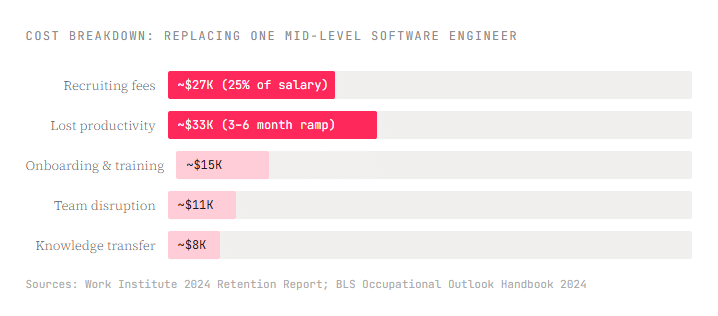
Beyond the financial toll, there is the developer experience impact. When engineers leave, the remaining team takes on extra workload, faces project delays, and experiences a dip in morale that can trigger further departures. Research by Corporate Navigators found that 73% of hiring managers believe turnover places a heavy burden on remaining employees, creating the conditions for the very churn it follows.
“By 2030, businesses are expected to lose $430 billion due to low talent retention. Yet most organizations still treat retention as a reactive HR task rather than a proactive engineering investment.” — Bucketlist Rewards, Tech Attrition Research 2025
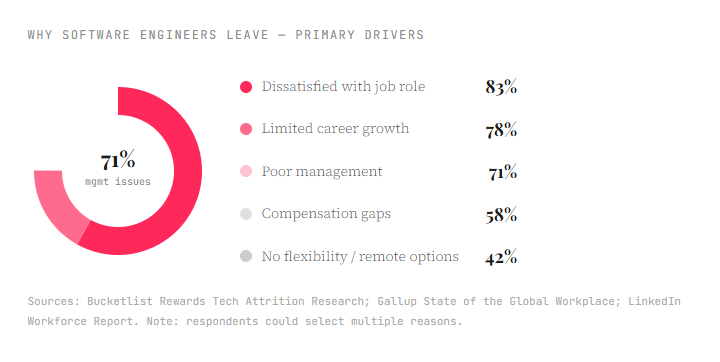
A persistent myth in talent management is that engineers leave for money. Compensation matters, but it is rarely the dominant driver. Gallup research indicates that 71% of voluntary departures trace back to poor management quality, not pay. Among tech employees specifically:
There is another important dimension: timing. Mercer research analyzing 365,000 employee records found that engineers are most likely to quit between two and five years of tenure. The pattern suggests that the first two years are a settling-in phase. When engineers reach the point where they can see clearly whether the company will invest in their growth, and the answer is no, they start looking. That two-to-five-year window is when most retention strategies either pay off or fail.
Compensation is not always the reason engineers leave, but it is often the permission slip. If an engineer is unhappy with their work and also discovers they are underpaid relative to the market, the decision to leave becomes easy.
“Competitive” in engineering means knowing your specific market, not just national averages. A senior full-stack developer in Austin faces different market rates than one in Miami, Buenos Aires, or Medellín. IT staff augmentation models increasingly allow companies to build globally competitive teams without the geographic pay premiums of pure US-based hiring.
Transparency matters as much as the numbers. Engineers respond well to documented pay bands, clear promotion criteria, and open conversations about total compensation, including equity. Companies that publish pay ranges and explain promotion logic consistently see lower voluntary attrition than those that treat compensation as a negotiation secret.
Practically, this means running market benchmarking at least annually, not just at hire. An engineer who was paid competitively at onboarding and receives flat increases for three years will find themselves 15–20% below market by the time they notice — and by then, they are already fielding recruiter calls.
78% of departing tech employees cite limited career growth as a primary reason for leaving. This is not just about promotions. It is about engineers being able to see a path forward inside the organization: a plausible, specific sequence of skills, projects, and milestones that leads to where they want to go.
Most companies have a career ladder on paper. Very few make it concrete. The difference between a ladder that retains people and one that does not comes down to specificity: what skills does a Senior Engineer need to demonstrate to reach Staff level? What projects will they own? Who will mentor them? When companies cannot answer these questions clearly, engineers assume the answer is “it depends on the manager’s mood” — and they look elsewhere.
AI and machine learning specializations are a particularly high-stakes area right now. Engineers with AI skills are commanding 20–40% salary premiums, and the companies most likely to retain them are not those paying the most — they are those offering the most meaningful work. Investing in AI upskilling programs and giving engineers time to work on AI initiatives is both a retention strategy and a product strategy.
Organizations with comprehensive development programs achieve 87% higher retention rates, according to SHRM research.
54% of voluntary departures happen within the first six months. This is the most preventable category of turnover, and it is almost entirely an onboarding problem. Poor onboarding sends a silent message to new hires: you are not important enough for us to have prepared for you.
For engineering teams, great onboarding has a specific shape. It starts before day one, with environment setup instructions, codebase documentation, and a clear list of the first week’s goals. It includes a dedicated onboarding buddy who is not the direct manager. It involves structured checkpoints at 30, 60, and 90 days, where the new engineer can raise concerns without fear.
The goal is to get engineers to their first meaningful contribution as quickly as possible. Research consistently shows that time-to-first-commit is a leading indicator of long-term retention. Engineers who ship something real in their first two weeks are far more likely to still be at the company in two years.
The data on remote work and retention is now settled enough to act on. Remote-first companies have retention rates of 94.2% compared to 81.6% for fully in-office organizations, and 78% of remote workers cite work-life balance as the primary driver of their loyalty. For engineering roles specifically, flexibility is not a perk — it is a baseline expectation.
Retention rate comparison:
Mandating full-time office attendance without a compelling reason is now a risk factor for voluntary turnover. Hybrid models that give engineers genuine flexibility consistently outperform rigid policies on retention. Balancing hybrid work with client satisfaction is a strategy in itself, and one worth getting right.
If 71% of voluntary exits trace back to management, then improving manager quality is the highest-leverage retention intervention available. Yet most companies invest heavily in technical training and almost nothing in developing their engineering managers.
The specific behaviors that drive engineering team attrition are well documented: micromanagement of technical decisions, inconsistent feedback, lack of advocacy for the team’s work at the leadership level, and failure to foster psychological safety for early problem raising.
Measuring manager effectiveness as a retention metric — not just a performance one — is a meaningful shift. Regular anonymous team health surveys, 360-degree feedback for engineering managers, and investment in management coaching are among the highest-ROI retention tools available. Gallup research shows that great managers cut departure risk by 40% compared to average ones.
AI-native engineering teams require a new kind of manager: one who understands both the technical and human dimensions of building software in an AI-augmented environment.
Only 38% of organizations currently use predictive turnover analysis, meaning the majority are still managing retention reactively — finding out an engineer is leaving when the resignation arrives. By that point, the outcome is already decided.
Effective retention analytics does not require sophisticated machine learning tools. It starts with consistent measurement: quarterly engagement surveys, regular one-on-ones with structured notes, and exit interview data analyzed for patterns rather than individual cases. The signals that precede voluntary departure are usually present three to six months before the resignation: declining engagement scores, reduced participation in optional team activities, and a pattern of asking fewer questions.
The 2- to 5-year tenure window identified by Mercer research is when proactive outreach matters most. A check-in conversation with a two-year engineer asking specifically about their career trajectory and whether there is anything the organization could do differently — conducted before they have made a decision — is far more effective than any retention bonus offered after the resignation.
For organizations building development delivery squads, analytics also means tracking project team health as a leading indicator of talent risk. Engineers on struggling projects with unclear priorities and constant context-switching are disproportionately likely to disengage and ultimately leave.
There is a category of turnover that retention strategies cannot fully solve: the structural mismatch between headcount and demand. When projects scale up and companies hire aggressively to meet them, then the project ends, and layoffs follow, the cycle itself erodes trust and increases voluntary turnover in subsequent years.
Software outsourcing and nearshore team models offer one structural solution. By maintaining a core permanent team supplemented by dedicated nearshore engineers who can scale with demand, organizations reduce the pressure to over-hire during peaks, which in turn reduces involuntary turnover that damages trust and culture. Scaling remote teams rapidly without sacrificing quality or culture is a skill that separates companies that retain talent from those that continually restart.
Replacing a US-based senior engineer costs upto $160,000. A well-integrated nearshore engineer in Latin America, working in the same time zone as a US team, costs a fraction as much to onboard and can often be brought on faster. For companies experiencing recurring turnover in specific technical roles, the nearshore model reduces exposure to the cost cycle while maintaining team continuity.
“Companies with comprehensive retention strategies achieve 87% higher retention rates and 67% lower recruitment costs than those without formal programs.” — SHRM Employee Job Satisfaction Report
A retention rate above 90% is generally considered healthy in the tech industry. The average annual turnover rate in tech hovers around 13.2%, meaning the average company retains roughly 87% of its workforce year-over-year. High-performing engineering organizations often achieve 92–95% retention by investing proactively in compensation benchmarking, career pathing, and team culture.
Research shows that 83% of tech employees who leave cite dissatisfaction with their roles, and 78% cite limited career growth as a primary driver. Gallup data indicate that 71% of voluntary exits are attributable to management quality rather than pay. Other common causes include lack of flexible work options, poor onboarding, and the absence of clear advancement paths.
Replacing a technical professional typically costs about 80% of their annual salary, including recruiting fees, onboarding, lost productivity, and knowledge transfer. For a senior software engineer earning $150,000 to $200,000 per year, that translates to a replacement cost of upto $160,000 per departure.
Yes. Research suggests that roughly 75% of voluntary employee turnover is avoidable. Employees who leave often do so for reasons employers could have addressed — such as management practices, lack of recognition, limited growth, or absence of flexible work arrangements. The key is to identify at-risk employees early and act on engagement data before the resignation letter arrives.
It can be a meaningful part of the solution. Nearshore staff augmentation gives companies access to pre-vetted engineering talent without the full hiring cycle, reducing disruption from internal turnover. It also allows teams to scale during high-demand periods without over-hiring permanently. Companies that specialize in dedicated nearshore squads — with engineers who integrate into client teams long term — often see greater continuity than pure freelance or project-based models.
Tech employee turnover is not an HR problem that resolves itself when the job market softens. The 13.2% annual attrition rate the industry carries has persisted through hiring booms and freezes alike, because its root causes — poor management, unclear career paths, weak onboarding, and structural over-hiring — are organizational, not cyclical.
The companies that consistently retain their best engineers share a common pattern: they treat retention as an engineering problem, not a feelings problem. They measure it, instrument it, and intervene early based on data rather than waiting for resignation letters to arrive. They invest in manager quality as deliberately as they invest in technical tooling. They build career paths specific enough to be believable. And they design their team structures — including the mix of permanent and nearshore talent — to avoid the boom-and-bust hiring cycles that erode trust over time.
None of the seven strategies in this article requires a large budget to start. Most require consistency more than spending: regular benchmarking, structured onboarding, honest one-on-ones, and a genuine willingness to act on what engineers tell you. The organizations that do this well do not just reduce turnover — they build teams where leaving becomes the harder choice.
If recurring attrition is a pattern your organization keeps cycling through, our dedicated nearshore engineering squads are built for long-term team integration, not short-term project coverage.
Schedule a conversation to talk through what a more stable team structure could look like.