Mar. 27, 2026

14 minutes read
Share this article
Last Updated March 2026
When you develop health applications for wearable technology, you need to work with platforms like Wear OS, watchOS, and Tizen. Each platform provides specific SDKs and development tools that let you access device sensors and health monitoring features. Android Studio serves as the primary development environment for Wear OS applications, while Xcode handles watchOS development.
Your wearable app development process should prioritize glanceable information that users can access quickly. Real-time notifications need to display critical health data without requiring extended interaction. You can use emulators during early development stages, but testing wearable apps on actual hardware becomes necessary to validate sensor accuracy and performance optimization.
| Platform | Development Tool | Key Features |
|---|---|---|
| Wear OS | Android Studio | NFC support, Android Wear compatibility |
| watchOS | Xcode | Health sensors, contactless payments |
| Tizen | Tizen Studio | Cross-platform development options |
Power efficiency remains critical when designing apps that continuously process health data. Background processing must be carefully managed to extend battery life while maintaining monitoring accuracy. Your UI/UX design should account for small screen sizes and limited interaction time.
Hardware integration connects your application to biosensors that track vital signs and cognitive indicators. You need to implement customized notifications that alert users to important health changes without causing alarm fatigue. Prototyping helps you test user experience flows before committing to full development. Cross-platform development frameworks can reduce development time, though they may limit access to platform-specific health APIs. The app stores for wearable platforms have specific requirements for health applications that you must meet before distribution.
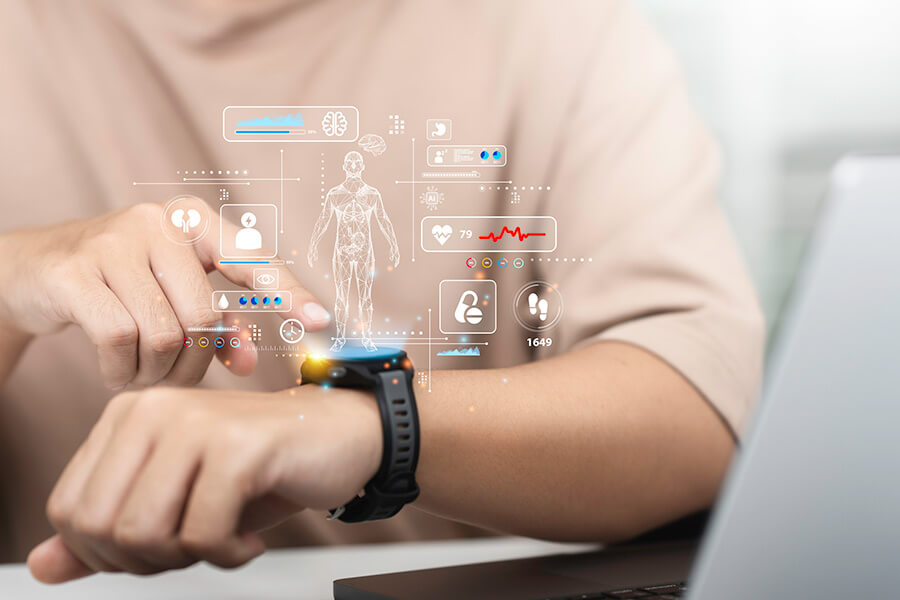
Early fitness trackers simply counted steps and logged basic activity levels. Modern smartwatches and wearable devices now monitor complex health metrics, including heart rhythm irregularities, blood glucose levels, and potential health issues before symptoms appear.
Your wearable sensors capture real-time environmental exposures and physiological responses. Advanced ECG sensors detect changes in skin temperature, heart rate variability, and sleep patterns with medical-grade accuracy. The shift from consumer fitness devices to clinical-grade monitoring tools has changed how you receive healthcare.
Wearable devices now integrate with electronic health records and provide continuous patient data to your medical professionals. These improvements enable the detection of subtle physiological changes that traditional monitoring methods might miss. Blood oxygen saturation monitoring has become standard in consumer devices, with accuracy approaching clinical-grade equipment.
| Device Generation | Primary Functions | Accuracy Level |
|---|---|---|
| First Generation (2010-2015) | Step counting, basic activity tracking | Consumer-grade |
| Second Generation (2015-2020) | Heart rate, sleep tracking, GPS | Enhanced consumer-grade |
| Third Generation (2020-2026) | ECG, blood oxygen, temperature, irregular rhythm detection | Medical-grade |
Machine learning transforms raw sensor data into actionable health insights. Your fitness tracking apps now use AI algorithms to analyze patterns across multiple vital signs and identify early warning signs of medical conditions.
AI-powered wearables can predict cardiac events, detect irregular heart rhythms, and monitor chronic conditions like diabetes. The algorithms continually learn from your biometric data to enhance prediction accuracy and minimize false alerts. Modern devices process thousands of data points per second to generate meaningful health metrics.
Smart devices filter noise from genuine health signals and adapt to your individual baselines over time. Machine learning models analyze your behavioral patterns and physiological markers to assess both physical and psychological well-being. These systems provide personalized insights based on your unique health patterns rather than generic population averages.
IoT connectivity enables your wearable sensors to communicate with other health monitoring systems. This integration creates a comprehensive picture of your health status across multiple data sources.
Your medical wearables must meet strict regulatory standards for accuracy and safety. Manufacturers implement multiple layers of encryption to protect your sensitive health information from unauthorized access.
Data transmission between wearables and healthcare systems requires secure protocols. End-to-end encryption ensures your patient information remains protected during wireless communication and cloud storage. HIPAA compliance in the United States and GDPR requirements in Europe mandate specific data protection measures for your health information.
Privacy protections include:
Sensor accuracy verification ensures your device readings meet clinical standards. Regulatory agencies evaluate wearable devices for electromagnetic compatibility and biocompatibility to ensure they operate safely and do not interfere with other medical equipment.
Your wearable devices enable personalized healthcare by establishing individual baseline measurements. This approach allows for customized treatment plans tailored to your unique physiological patterns and health history.
Continuous monitoring data help your physicians adjust medication dosages and treatment protocols in real time. You receive personalized recommendations for diet, exercise, and lifestyle modifications based on your specific health metrics. Fitness tracking capabilities extend beyond basic activity monitoring to provide targeted health interventions.
Your wearable platforms integrate genetic information with real-time biometric data to predict disease risk. This combination enables proactive interventions before health problems develop into severe conditions. Sensor integration across multiple data streams creates comprehensive health profiles that adapt as your needs change.
The technology supports independent living through monitoring of cognitive function, mobility patterns, and medication adherence. Your personalized insights help maintain health and wellness throughout different life stages.
Cognitive enhancement technologies now extend far beyond simple health tracking. These devices interact directly with your nervous system to actively improve mental capabilities. Neuro-motor-controlled wearable augmentations create seamless connections between your thoughts and technological responses through brain-computer interfaces.
The systems work through several core mechanisms. Neural signal detection is achieved through EEG sensors embedded in headbands or caps you wear. Real-time processing analyzes your brain activity patterns as they occur. Adaptive feedback systems then respond to your cognitive states automatically.
These technologies also include memory augmentation tools that retrieve contextual information when you need it. The devices can detect when you experience cognitive overload and adjust environmental factors accordingly. Some provide prompts to optimize your mental performance at critical moments.
Brain-computer interfaces represent the most advanced form available. These systems translate your neural signals into digital commands. You can control devices with thought alone while receiving cognitive support.
Some wearables now incorporate AR glasses that display information directly in your field of vision. This visual augmentation works alongside cognitive enhancement. You can access data without interrupting your workflow or mental processes.
Healthcare applications focus on therapeutic intervention and rehabilitation support. Wearable devices now provide personalized cognitive training programs through artificial intelligence algorithms. The technology enables continuous monitoring outside clinical settings.
Mental health applications address multiple conditions. Anxiety detection works through physiological markers that your device tracks constantly. Depression monitoring analyzes your sleep and activity patterns over time. Stress management happens through biofeedback training that you complete daily. Cognitive behavioral therapy support tools guide you through exercises and coping strategies.
Neurorehabilitation applications target individuals recovering from brain injuries or neurological conditions. These devices provide structured cognitive exercises tailored to your specific needs. Progress tracking happens through measurable metrics that healthcare providers review.
You receive real-time feedback on your cognitive performance throughout the day. Healthcare providers have access to comprehensive data to inform treatment adjustments. This continuous loop creates more responsive care than traditional appointment-based models.
The technology demonstrates significant potential for improving independence and quality of life. Studies show that patients using cognitive wearables in rehabilitation settings achieve measurable improvements in daily functioning. Some devices incorporate gesture control interfaces that allow you to interact without physical buttons or screens.
Voice commands provide another method of interaction for cognitive-assistance wearables. You can request information or adjust settings without manual input. This hands-free approach reduces cognitive load during tasks.
Artificial intelligence transforms wearable cognitive augmentation from generic tools into personalized enhancement systems. Deep learning approaches achieve remarkable accuracy in analyzing your wearable signal patterns and predicting cognitive needs.
Machine learning algorithms process multiple data streams from your device simultaneously:
| Data Source | AI Application | Cognitive Benefit |
|---|---|---|
| EEG patterns | Attention state detection | Focus optimization |
| Heart rate variability | Stress level analysis | Mental resilience |
| Sleep metrics | Recovery assessment | Memory consolidation |
| Activity patterns | Fatigue prediction | Performance timing |
Personalization mechanisms include adaptive learning that adjusts to your individual cognitive patterns over time. The artificial intelligence systems identify the optimal timing for intervention. They customize feedback delivery methods based on what works best for you.
Advanced wearables incorporate predictive modeling to anticipate your cognitive needs before you experience difficulties. These systems learn from your behavioral patterns and environmental factors. They provide proactive support rather than reactive responses.
Augmented reality glasses with gesture controls offer new opportunities for personalization. You can customize your cognitive assistance interface through gestures that feel natural to you. The AR display adapts based on your preferences and cognitive state.
The integration of multiple AI technologies creates comprehensive cognitive assistance platforms. These platforms evolve with your requirements over time. Research indicates measurable improvements in mental performance metrics among users who regularly engage with personalized cognitive augmentation systems.
You should implement a layered architecture that separates concerns between the wearable device and a companion smartphone app. The wearable handles immediate sensor input and basic UI interactions while the phone manages complex processing and network requests.
Model-View-ViewModel (MVVM) works well for wearable platforms like Wear OS and watchOS. This pattern keeps your UI code separate from business logic, making it easier to update interfaces without breaking core functionality.
Consider using event-driven architecture for sensor data processing. Your app responds to discrete events rather than continuously polling sensors, which reduces CPU usage and extends battery life.
Local data caching is critical. You need to store essential information on the device so users can access features when Bluetooth connectivity drops. Implement a sync manager that updates data when connections are restored.
Start by choosing appropriate sampling rates for each sensor type. Accelerometers for step counting can operate at 10-50 Hz, while heart rate sensors typically sample at 1 Hz during resting periods and increase to 1-5 Hz during activity.
Apply low-pass filters to remove high-frequency noise from accelerometer and gyroscope data. A simple moving average filter over 5-10 samples smooths readings without introducing significant lag.
Sensor fusion combines multiple data sources to improve accuracy. You can merge accelerometer and gyroscope readings to detect motion patterns that neither sensor captures on its own. Kalman filters are effective for this purpose but require careful tuning.
| Sensor Type | Typical Sample Rate | Common Filter |
|---|---|---|
| Accelerometer | 25-50 Hz | Moving average |
| Gyroscope | 25-50 Hz | Low-pass |
| Heart rate | 1-5 Hz | Median filter |
| GPS | 0.1-1 Hz | Kalman |
Implement adaptive sampling that adjusts rates based on user activity. Switch to lower frequencies during inactive periods and increase when motion is detected.
Use the lowest brightness level that maintains readability. Display power consumption scales exponentially with brightness, so reducing it by 30% can extend battery life by several hours.
Leverage platform-specific low-power display modes. Wear OS offers ambient mode and watchOS provides always-on display states that refresh at 1 Hz instead of 60 Hz.
Batch network requests instead of making frequent small transmissions. Grouping API calls into 15-minute intervals reduces radio usage, which consumes significant power during active transmission.
Schedule background tasks during device charging periods when possible. You can perform data synchronization, software updates, and analytics uploads without impacting daily battery life.
Wake locks and background services should run only when absolutely necessary. Release CPU and network wake locks immediately after completing tasks. Set precise timeouts to prevent runaway processes.
Optimize animation frame rates on always-on displays. Reduce complex animations to 15-30 fps or use static updates when the device detects the user is not actively viewing the screen.
Limit background task frequency to essential operations. Most platforms restrict background execution to preserve battery life, so prioritize critical functions like health alerts and time-sensitive notifications.
Use platform notification systems rather than custom alert mechanisms. Wear OS and watchOS provide optimized notification APIs that handle display, haptics, and user interactions efficiently.
Implement notification grouping to prevent users from being overwhelmed. Bundle related alerts into single notifications that users can expand when needed, rather than delivering separate vibrations for each item.
Your app should respect quiet hours and activity contexts. Suppress non-critical notifications during sleep periods or during active workout sessions.
Set appropriate priority levels for different notification types. Reserve high-priority alerts with vibration for urgent health warnings or safety notifications. Use silent notifications for routine data updates.
Background processing should complete within the allocated time windows. Wear OS typically provides 10 minutes for background tasks, while watchOS offers shorter intervals. Design operations to finish quickly or resume gracefully if terminated.
Encrypt all health and biometric data both at rest and in transit. Use AES-256 encryption for stored data and TLS 1.3 for network communications. Never store sensitive information in plain text logs or temporary files.
Implement secure authentication before granting access to health data. Require a device PIN, biometric verification, or password confirmation when users view detailed health metrics or change privacy settings.
Minimize data collection to only what your app requires. Request specific sensor permissions rather than broad access, and clearly explain why each data type is necessary for your app’s functionality.
Process sensitive data locally on the device whenever possible. Performing calculations on the wearable or paired phone reduces the need to transmit raw biometric readings to cloud servers.
You must obtain explicit user consent before sharing health data with third parties. Provide granular controls that let users choose which data types can be shared and with which services.
Follow platform-specific health data regulations. Apple’s HealthKit and Google’s Health Connect have strict requirements for apps that access their frameworks, including a prohibition on data sales.
Implement data retention policies that automatically delete old health records. Users should be able to view, export, and permanently delete their data through your app interface.
Test on physical devices rather than relying solely on emulators. Wearable simulators cannot accurately reproduce sensor timing, battery drain, or thermal behavior that occurs on real hardware.
Use platform profiling tools to measure CPU usage, memory allocation, and energy consumption. Android Studio’s CPU Profiler and Xcode’s Instruments provide detailed metrics for identifying performance bottlenecks.
Monitor frame rendering times to ensure smooth animations. Your UI should maintain 60 fps during active use and meet platform requirements for ambient or always-on display modes.
Test Bluetooth connectivity across various scenarios, including weak signal strength, multiple paired devices, and rapid connection/disconnection cycles. Your app should handle pairing failures gracefully and retry with exponential backoff.
Implement thermal testing during extended use cases. Run your app continuously for 30-60-minute sessions while monitoring the device temperature. Operations that cause excessive heating will drain batteries and may trigger thermal throttling.
Create automated test suites that simulate sensor inputs and user interactions. You can replay recorded sensor data to ensure consistent processing results across app updates.
Verify battery consumption against baseline measurements. Test identical usage patterns before and after code
Wearable app development offers you significant opportunities across healthcare, fitness, and productivity sectors. The technology requires you to balance technical capabilities with practical constraints like battery life and screen size. Your success depends on selecting the right programming languages, understanding platform requirements for Wear OS or watchOS, and integrating cloud services for data synchronization.
You need to prioritize user experience while managing the unique challenges of small form factors and limited processing power. Security remains critical as wearables collect sensitive health data. The development process demands attention to sensor integration, API selection, and cross-platform compatibility. By focusing on performance optimization and intuitive design, you can create applications that users rely on daily for health monitoring and task management.
Edwin is a software engineer and Mobile Development Lead at Coderio who writes about app development across native, cross-platform, and web-based technologies. Drawing on hands-on experience with JavaScript and modern app architectures, he covers programming languages, frameworks, and engineering practices that help organizations choose the right technologies based on platform requirements, performance, and long-term scalability.
Edwin is a software engineer and Mobile Development Lead at Coderio who writes about app development across native, cross-platform, and web-based technologies. Drawing on hands-on experience with JavaScript and modern app architectures, he covers programming languages, frameworks, and engineering practices that help organizations choose the right technologies based on platform requirements, performance, and long-term scalability.
Accelerate your software development with our on-demand nearshore engineering teams.