

Imagine a company investing months of effort into a new product — only to find that it doesn’t resonate with a single customer. What went wrong? More often than not, the answer is the same: they skipped the most important step of all — deeply understanding the people they were building for.
Design thinking is a human-centered approach to problem-solving that puts the end user at the heart of every decision. It emphasizes empathy, creativity, and iterative experimentation to ensure that the solutions delivered are not only innovative but genuinely useful and meaningful.
Crucially, design thinking isn’t just for designers. Business leaders, software developers, product strategists, and operations teams across industries use the design thinking framework to reimagine their products, services, and company culture. It’s a universal problem-solving mindset — one that any organization can adopt to stay competitive in a fast-changing world.
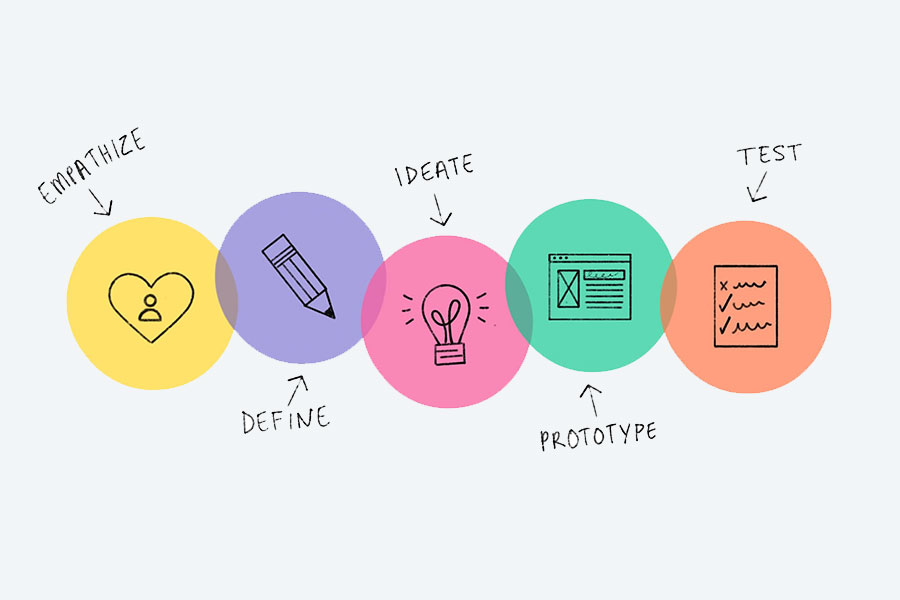
The design thinking process unfolds in 5 interconnected, iterative stages. These are not rigid steps in a linear sequence — teams frequently loop back and forth as they learn. Together they form a cycle of continuous discovery and refinement.
Conduct deep research through interviews, observations, and surveys. Understand users’ real needs, frustrations, and motivations — not your assumptions about them.
Synthesize insights into a sharp problem statement. Focus on user needs — not business goals. “Users struggle to navigate our app” beats “We need more downloads.”
Gather cross-functional teams and generate as many solutions as possible. No idea is too wild. This divergent thinking phase unlocks unexpected breakthroughs.
Build low-fidelity versions of your best ideas — sketches, wireframes, or basic models. Fast prototypes allow you to learn cheaply before committing resources.
Put prototypes in front of real users and gather honest feedback. Test continuously — not just once — so your solution evolves alongside actual user needs.
Pro tip: Design sprints (structured 5-day workshops that compress the full framework into a week) are one of the most effective ways to apply these stages quickly on real business challenges.
Beyond the five stages, design thinking is grounded in five foundational principles that shape how teams approach every challenge:
These principles aren’t just cultural values — they’re active behaviors. They push teams to question assumptions, stay curious in the face of complexity, and prioritize meaningful outcomes over technically impressive ones. Organizations that internalize these principles don’t just produce better products; they develop a durable competitive advantage rooted in how they think.
In today’s competitive landscape, the businesses that win aren’t necessarily those with the biggest budgets — they’re the ones that understand their customers most deeply. Design thinking bridges the gap between creative vision and practical execution, making it one of the most powerful strategic tools available.
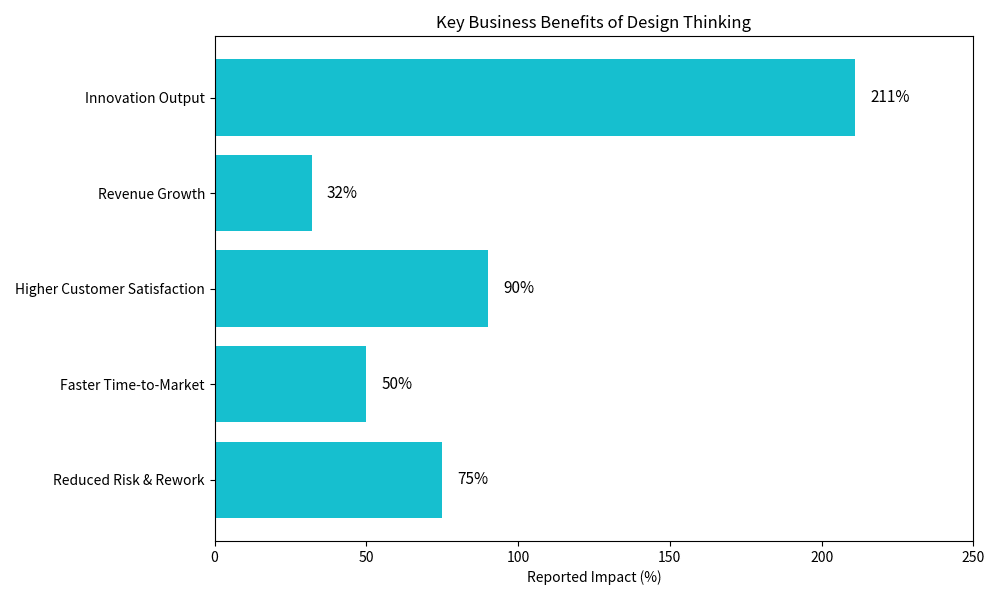
When applied to business strategy, design thinking delivers five distinct advantages:
Design-driven companies consistently report faster growth, stronger customer retention, and higher revenue — because when you solve problems people actually have, the results follow.
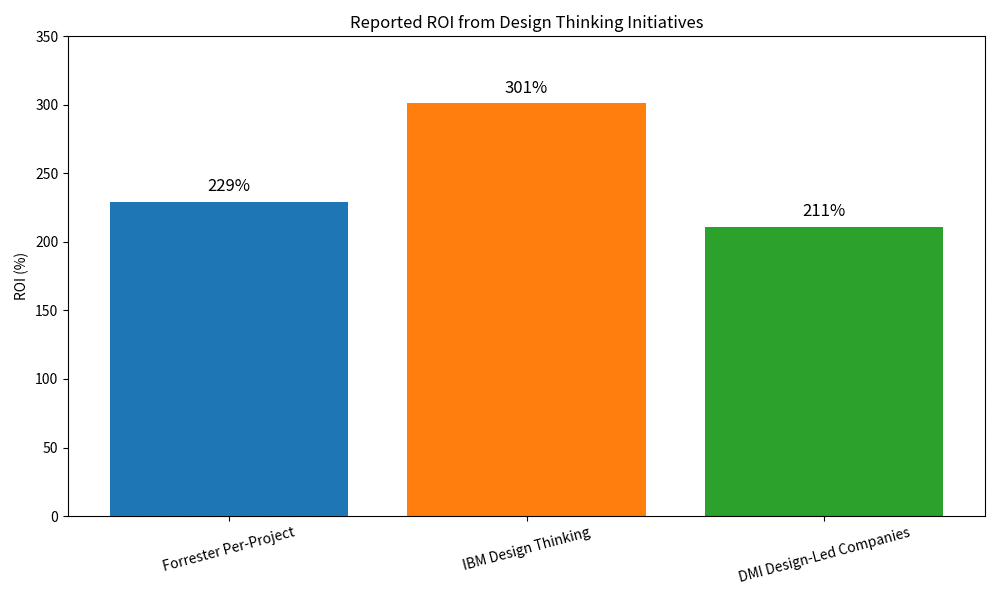
Key Sources:
- Forrester: Mature design thinking practices deliver 71–107% organizational ROI; median per-project ROI of 229%.
- IBM: Achieved 301% ROI on design thinking investments.
- Design Management Institute (DMI): Design-led companies outperformed the S&P 500 by 211% over 10 years.
- McKinsey: Design-driven organizations saw 32% higher revenue growth over five years.
These numbers turn design thinking from a “nice-to-have” into a strategic imperative.
Design thinking isn’t confined to tech startups or product teams. Its principles translate powerfully across virtually every industry:
Early in its journey, Airbnb was struggling. The founders had built a technically functional platform, but growth had stalled. Instead of doubling down on marketing, they did something radical: they visited their users in person and listened.
What they discovered reshaped everything. The real problem wasn’t awareness — it was that hosts had no good way to make their listings visually appealing. The photography was poor, the descriptions were vague, and guests couldn’t picture themselves staying there.
Armed with this empathy-driven insight, the team ideated, prototyped, and implemented features that helped hosts showcase their spaces more compellingly. The results were transformational. Airbnb went from struggling startup to global travel leader — powered not by technology, but by listening.
The Airbnb story illustrates the core promise of design thinking: when you truly understand your user’s problem, the path to a meaningful solution becomes clear. The methodology isn’t just a creative exercise — it’s a strategic weapon.
For software teams, design thinking is the difference between building a product that works and building one that people love. By centering user needs throughout the development process, not just at the beginning, software development teams produce digital experiences that are genuinely useful and delightful.
Design thinking and agile development are natural partners. While agile provides the structural cadence — sprints, retrospectives, continuous delivery — design thinking provides the human intelligence that informs what gets built and why. Together, they create a loop of rapid learning: understand the user, build a small version, test it, improve it.
In practice, this means developers participate in user research, not just specification reviews. It means UX designers are embedded in engineering sprints. It means product decisions are made with reference to real user feedback rather than internal consensus. This user-centered development approach reduces rework, accelerates adoption, and produces software that earns loyalty.
Modern software teams use a spectrum of prototyping tools — from paper sketches and Figma wireframes to interactive click-through demos and limited beta releases. Each level of fidelity serves a purpose: quick sketches test concepts, interactive prototypes validate flows, and beta releases capture real-world behavior. The goal is always the same: learn fast, fail cheap, and improve continuously.
For companies leveraging IT staff augmentation or partnering with nearshore software teams, design thinking plays an additional role: it provides a shared creative language that aligns in-house stakeholders with external developers around a common vision from day one.
Applying design thinking to a single project is valuable. Embedding it into how an organization thinks and works is transformational. The shift from tactical application to cultural adoption is what separates companies that occasionally innovate from those that do so consistently.
Culture starts at the top. Leaders who champion design thinking — who ask empathy questions in meetings, who celebrate learning from failed prototypes, who protect space for experimentation — signal to the entire organization that this approach is valued, not just tolerated.
Sustaining a design thinking culture requires ongoing investment in people. Workshops, mentorship programs, and opportunities to apply the framework on live problems keep teams engaged and growing. The skills of curiosity, empathy, and creative problem-solving compound over time — making every team member more valuable.
Design thinking thrives when people from different disciplines — product, engineering, marketing, operations — work together rather than in silos. Cross-functional squads, shared project ownership, and common tooling create the conditions for the kind of diverse thinking that generates breakthrough solutions.
Key insight: Design-driven organizations consistently outperform their peers on growth, profitability, and customer satisfaction metrics. Culture isn’t a soft priority — it’s a business strategy.
Adopting design thinking is not without friction. Three challenges consistently arise — and each can be addressed with clear strategy:
Design thinking is supported by a rich toolkit of practical techniques. Mastering even a handful of these can dramatically improve how your team works:
Design thinking is evolving rapidly — not in its core principles, but in the tools and contexts through which it’s applied. Several emerging trends are reshaping what the practice looks like in 2026 and beyond.
AI and machine learning are transforming the research and synthesis phases of design thinking. Natural language processing can analyze thousands of user interviews in minutes. Behavioral data reveals patterns that no manual review could surface. Data analytics gives designers deeper, more actionable insights into what users actually need.
Virtual and augmented reality tools allow teams to prototype physical and spatial experiences — store layouts, healthcare environments, manufacturing workflows — with a level of fidelity previously impossible. Testing becomes richer, and learnings arrive faster.
Remote-first design sprints, virtual whiteboards, and asynchronous ideation tools have opened design thinking to globally distributed teams. The methodology has proven resilient across time zones — making it more accessible and more scalable than ever.
Organizations are expanding the scope of design thinking beyond individual products to tackle larger systemic challenges — supply chains, urban infrastructure, and climate adaptation. The same five stages that solve a mobile UX problem can be applied to redesigning a healthcare system or a city’s public transit network.
Design thinking is one of the most battle-tested innovation methodologies available to modern businesses. By rooting strategy in genuine human empathy, structuring creativity through a five-stage framework, and building iterative feedback into every phase of execution, it enables organizations to consistently produce solutions that matter.
The question isn’t whether design thinking works — the evidence is overwhelming. The real question is: are you ready to put your users at the center of everything you build?
Key Takeaways
- Design thinking is a human-centered, iterative framework — not a linear checklist. Revisit stages as you learn.
- Its five stages — Empathize, Define, Ideate, Prototype, Test — apply equally to product development, business strategy, and organizational design.
- When combined with agile methodologies, design thinking creates a powerful engine for continuous improvement.
- Building a design thinking culture — not just applying the process — is what delivers sustained competitive advantage.
- Whether you’re working with IT staff augmentation, dedicated delivery squads, or outsourced software development, design thinking provides the shared language and process that aligns teams around user value.
Coderio’s nearshore engineering teams bring design thinking principles into every project — from first sprint to the final delivery. Schedule a Call