
Last Updated February 2026
Autonomous robotics in logistics has moved from isolated warehouse pilots to a core operating model for distribution, fulfillment, and internal transport. As companies expand digital operations and connect robotics to broader artificial intelligence services, they are not simply replacing manual movement with machines — they are redesigning how inventory flows, how orders are released, and how decisions are made across facilities.
The practical value of this shift comes from combining robotics with software, sensor data, and operational logic. In that sense, the role of robotics in supply chain execution is closely tied to improvements in forecasting, route selection, and exception handling that are also visible in broader discussions of machine learning benefits. When these systems are deployed well, they reduce travel time, lower picking friction, improve throughput, and create more stable service levels under demand volatility. The companies seeing the strongest returns are those treating autonomous robotics as an operating model upgrade — not a hardware purchase.
Autonomous robotics in the logistics industry refers to robotic systems that can sense their environment, make bounded decisions, and execute physical tasks with limited direct human control. Unlike fixed automation that repeats the same motion in the same place, autonomous systems adapt to changing warehouse conditions — congestion, variable order priorities, shifting inventory locations, and the presence of people or other machines.
In logistics settings, autonomy depends on a combination of:
This matters because logistics environments are rarely static. Dock activity changes by hour. Pick density shifts by product mix. Returns create reverse flows. Seasonal surges compress cycle times. A useful robot in this context must do more than move — it must respond.
Autonomous robots deliver results only when the technical stack is aligned with the process stack. The machine itself is only one layer.
Robots need to identify obstacles, understand travel paths, detect load status, and recognize landmarks or markers. This depends on sensor fusion rather than one sensor alone. Cameras support visual identification. LiDAR helps with spatial mapping. Barcode and RFID tools connect the physical environment to transaction records.
There are three main navigation approaches: fixed-path navigation (commonly used in simpler AGV environments), dynamic mapping (where robots generate or update operational maps as they move), and hybrid approaches that combine known routes with adaptive obstacle avoidance. The more variable the facility, the more valuable adaptive navigation becomes — which is why autonomous mobile robots have gained traction in facilities that need flexibility without major infrastructure rebuilds.
Autonomous Guided Vehicles (AGVs) follow predetermined paths using magnetic strips, wires, or laser guidance. They handle heavy payload transportation between warehouse zones and loading docks. Autonomous Mobile Robots (AMRs) use dynamic navigation and obstacle avoidance to move freely, adapting routes in real-time without infrastructure modifications. Collaborative robots (cobots) work directly with human employees in picking and packing. Sorting robots integrate with conveyor systems to manage package flow. Inventory drones conduct aerial stock counts across rack locations.
| Robot Type | Primary Function | Navigation Method |
| AGVs | Heavy transport | Fixed pathways |
| AMRs | Flexible picking & transport | Dynamic mapping |
| Sorting robots | Package sorting | Conveyor integration |
| Inventory drones | Stock counting | Aerial navigation |
The real performance gains often come from fleet software rather than the robot chassis. Orchestration determines which robot should perform which task, in what order, along which route, and under which constraints. Strong fleet management reduces idle time, prevents traffic bottlenecks, and balances work across zones. That is why many deployments become part of a larger digital transformation program rather than a stand-alone equipment purchase — robotics changes data flows, task ownership, and exception management at the same time.
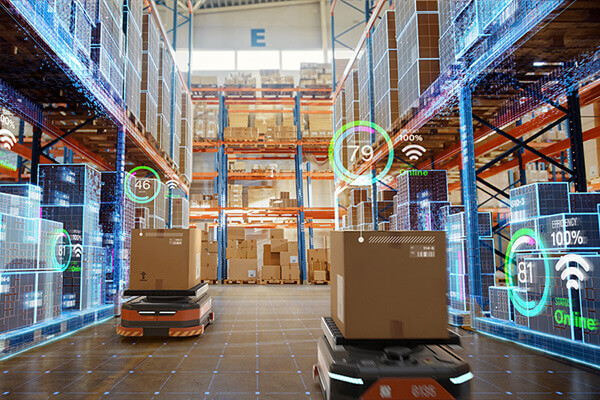
The strongest use cases are not always the most visible ones. Last-mile robots and drones attract attention, but the most durable returns often come from internal warehouse movement, repetitive transport, and process synchronization.
Robots can move received goods from docks to staging or storage zones, reducing forklift traffic in dense areas and shortening the time between receipt and inventory availability. In facilities with frequent replenishment cycles, this improves slotting discipline and decreases aisle congestion.
In person-to-goods environments, AMRs travel with associates, carry totes, guide pick paths, and reduce walking time. In goods-to-person setups — pioneered at scale by Amazon Robotics — robots bring inventory containers or shelves to workstations, allowing operators to focus on selection and verification rather than movement.
Autonomous systems can move orders between picking, packing, quality control, and shipping. This is especially useful where order profiles vary throughout the day and conveyor-heavy designs would be too rigid or too expensive to modify.
Robotic pallet movers and mobile platforms handle repetitive transport between storage, production, and shipping areas. These use cases are often the easiest to justify financially because the activity is frequent, measurable, and operationally consistent.
Some robots are designed to scan rack locations, confirm stock positions, read labels, and flag discrepancies. This improves cycle counting and helps maintain better data quality without requiring broad manual audit programs — a meaningful benefit in multi-SKU environments.
Although less mature than warehouse use cases, autonomous equipment is increasingly used to coordinate trailer moves, dock scheduling, and short-distance transfers within controlled logistics campuses. This is an area to watch as the technology matures.
The main gains are operational, but they also affect planning, labor allocation, and service reliability.
A credible robotics strategy starts with process economics, not novelty. The strongest business cases come from workflows that are repetitive, measurable, and constrained by distance or labor variability. A useful evaluation framework includes:
Return on investment should be assessed in layers. Direct labor savings matter, but they rarely tell the whole story. Many projects are justified by a combination of reduced overtime, faster order flow, improved inventory accuracy, fewer safety incidents, and stronger peak execution. It is also important to distinguish between replacing a task and stabilizing a process — in many facilities, robotics delivers more value by making output predictable than by eliminating headcount.
Autonomous robotics fails most often when the technology is asked to compensate for process ambiguity.
Companies that succeed with autonomous robotics in logistics typically follow a staged approach:
The best outcomes from autonomous robotics come from role redesign, not simple substitution. People remain essential for judgment, escalation, quality review, equipment recovery, and non-standard work.
A practical human-robot model assigns:
This changes labor demand in important ways. Facilities need fewer hours devoted to walking and manual transfer, but more capability in monitoring, troubleshooting, and systems-based decision-making. For organizations planning that broader shift, a structured digital transformation strategy helps connect robotics investments to process ownership, governance, and operating model changes.
Several trends are shaping the next phase of adoption:
Robotics platforms are moving toward mixed-fleet management, where different robot types — tote movers, pallet robots, scanning devices — operate under shared task logic. That allows facilities to combine capabilities without fragmenting control.
Robots are increasingly tied to predictive allocation, dynamic slotting, and real-time exception prioritization. These capabilities depend on stronger data foundations and mature machine learning services that support operational decisions without sacrificing interpretability.
As facilities deploy equipment from multiple vendors, interface standards and system transparency become more important. Organizations such as NIST continue to shape the broader environment for reliable automation, safety, and measurement in this space.
Autonomy will continue spreading into yards, micro-fulfillment environments, hospital logistics, manufacturing intralogistics, and selected last-mile operations. The pace will vary by site complexity, economics, and local operating constraints.
Autonomous robotics in logistics is most useful when treated as an operating model upgrade rather than a hardware purchase. Its value comes from connecting robotics, software, data, and workflow design into a system that moves inventory with greater consistency and less friction.
The most successful deployments start with a clearly defined process problem — not a broad ambition to automate everything. They target repetitive movement, connect robots to execution systems, redesign human roles, and expand only after proving measurable gains. Companies that take this disciplined approach are not just cutting costs; they are building supply chains that are faster, more accurate, and genuinely resilient under pressure.
For organizations evaluating where to start, the right question is not ‘which robot should we buy?’ — it is ‘which process problem do we need to solve?’ That shift in framing is what separates successful deployments from expensive pilots that never scale. If you’re ready to explore how digital transformation services can support your robotics strategy, the conversation starts with the process, not the technology.