Apr. 21, 2026

19 minutes read
Share this article
Last Updated April 2026
Enterprise AI breaks down less often due to model quality than to system access. Once teams move beyond demos, they discover that the hard part is not generating text but connecting a model to the right tools, data, and permissions at the right time. That challenge is especially visible when organizations are already integrating AI into legacy systems, where every additional connector can introduce more cost, risk, and maintenance work. The scale of that burden is significant. Research from MuleSoft found that enterprises manage an average of 1,061 applications, but only 29% of those are integrated — meaning the majority of enterprise systems still operate in silos that AI cannot reach without custom wiring.
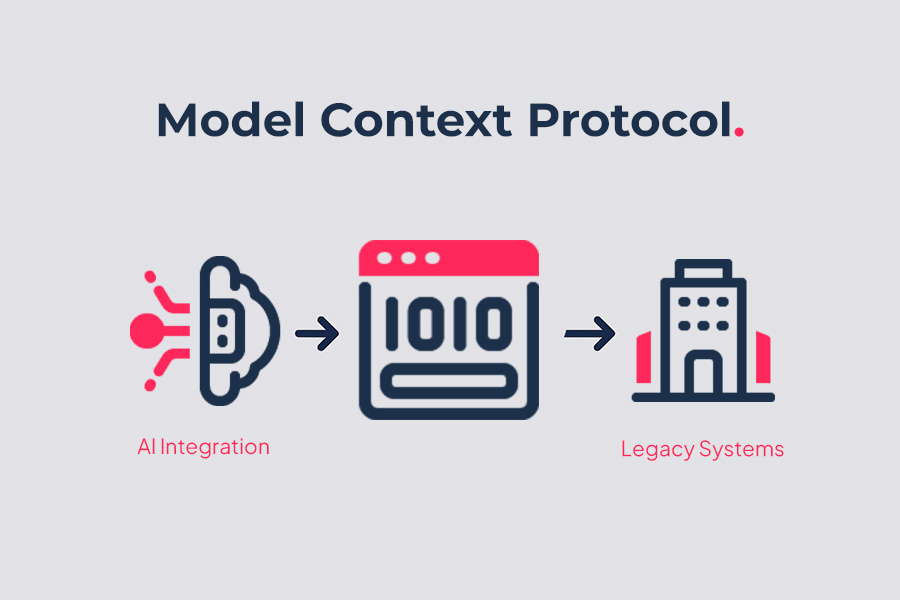
Model Context Protocol, or MCP, is one answer to that problem. Introduced in late 2024, it defines a standard way for AI applications to interact with external systems, rather than relying on a separate custom integration for each model and tool. In practice, that makes MCP relevant to teams building internal assistants, operational copilots, agent workflows, and custom software development services that depend on live enterprise context.
Most enterprise AI stacks begin with a familiar pattern. A model is connected to one database, one search endpoint, one ticketing system, and one internal API. The first workflow works. The second takes longer. By the fifth or sixth integration, the architecture becomes difficult to govern because every connection is slightly different.
This is the underlying scaling problem that MCP addresses.
Without a standard protocol layer, teams often face an N x M integration burden:
MCP does not replace enterprise systems or application APIs. It standardizes how AI applications discover and use them.
That distinction matters. The protocol turns integration from a repeated custom coding exercise into a reusable interface model. Instead of writing bespoke logic for each assistant, teams can expose capabilities once and make them available to compatible clients under a common contract.
At a high level, MCP follows a host-client-server architecture. This is more precise than describing it as a simple client-server pattern, as the host plays an important operational role.
The original architecture centers on three primary components:
A host application can manage multiple client instances, while each client maintains a 1:1 relationship with a particular server. That isolation is useful in enterprise settings because it helps separate concerns across systems, scopes, and trust boundaries.
A practical example makes the pattern easier to see:
The AI experience may appear unified to the user, but the underlying access paths remain separate.
MCP uses JSON-RPC 2.0 for message exchange. That gives implementations a common request-response structure for discovery, invocation, notifications, and error handling.
A typical flow looks like this:
This design keeps the model-facing experience consistent even when the underlying systems are different.
One of the most useful aspects of MCP is that it separates different capability types rather than treating every external dependency as a generic function call.
That separation improves both usability and governance.
For example:
When everything is flattened into a single tool list, the AI layer becomes harder to reason about. MCP gives teams a cleaner way to expose context, actions, and reusable workflows as distinct primitives.
MCP can support local process communication and remote service connections, which makes it useful across different operating models. Local patterns are often appropriate for desktop tools, developer environments, or tightly controlled workstation workflows. Remote patterns are better suited to shared enterprise services, team-wide deployments, and centrally managed integrations.
This is where a protocol-based approach becomes more useful than ad hoc glue code. The same operational contract can span local files, cloud systems, and internal platforms without forcing the AI application to learn a different integration style for each one. Teams already dealing with heterogeneous estates often see the same value when working through broader API integration patterns.
MCP is easier to place correctly when it is compared with nearby concepts that it does not replace.
An API exposes application functionality. MCP defines how AI applications discover and use external capabilities through a common interaction model.
An enterprise system may still keep its REST, GraphQL, or event-driven interfaces. MCP sits above that layer and presents AI-friendly access in a more standardized way.
Function calling lets a model produce structured calls. MCP provides a standard contract for how those callable capabilities are exposed, described, discovered, and governed across systems.
In other words, function calling is a model behavior. MCP is an interoperability layer.
RAG helps a model retrieve relevant information before generating a response. MCP can expose retrieval mechanisms, but it goes beyond retrieval.
RAG is usually strongest when the main problem is the need for factual grounding in a knowledge base. MCP becomes more useful when the system also needs to:
The two approaches are often complementary rather than interchangeable. In some cases, a knowledge-rich design informed by knowledge graphs and operational context can strengthen what MCP-connected tools and resources deliver to the model.
| API | Function Calling | RAG | MCP | |
|---|---|---|---|---|
| What it is | An interface that exposes application functionality | A model behavior that produces structured calls to defined functions | A pattern for retrieving relevant context before generation | A protocol that standardizes how AI discovers and uses external capabilities |
| What problem it solves | Exposing system capabilities to any consumer | Letting a model trigger structured actions | Grounding model responses in current or proprietary knowledge | Reducing integration fragmentation across multiple models and enterprise systems |
| Where it lives | Application layer | Model layer | Retrieval layer | Interoperability layer |
| Best for | General application integration | Single-model, single-workflow tool use | Knowledge-grounded Q&A and document search | Multi-system, multi-agent, reusable enterprise integration |
| Replaces MCP? | No — APIs are what MCP servers wrap | No — function calling works within MCP | No — RAG pipelines can be exposed through MCP servers | — |
The practical takeaway is that these four concepts are not alternatives. A production MCP integration will likely sit above existing APIs, use function calling as the invocation mechanism, and include RAG as one of its exposed resources. Each layer has a different job.
The business case for MCP is not that it makes models smarter on its own. The value comes from reducing integration friction while improving operational control.
When each assistant requires a separate connector for each system, AI programs stall under the burden of their own maintenance. MCP allows teams to expose a capability once and reuse it across compatible hosts. That changes the cost profile of expansion. For context, custom API integrations in enterprise environments cost an average of $3,000 to $8,000 each to build and maintain annually, according to benchmarks from integration platforms — and that figure compounds quickly as the number of AI workflows grows.
A model without access to live tools and current data is limited to what is already in its prompt or training history. MCP improves access to operational context, which is critical for tasks such as:
Because the integration logic sits behind a protocol boundary, organizations have greater flexibility when changing host applications or model providers. That does not eliminate migration work, but it reduces the amount of business-system wiring that must be rewritten.
MCP encourages focused servers with clear responsibilities. That helps teams assemble workflows from smaller, controlled components rather than building one oversized integration service. The same discipline tends to support cleaner cloud-native application development, where modularity matters for both scale and change management.
Enterprise deployments may need to support hundreds of AI agents accessing shared systems simultaneously. That is not hypothetical. According to Gartner, by 2028, 33% of enterprise software applications will include agentic AI — up from less than 1% in 2024. At that scale, an integration model that requires custom wiring per agent per system becomes operationally unmanageable without a protocol layer. In that setting, the value of standard session handling, capability discovery, and consistent governance becomes much more concrete. Without those controls, concurrency and access sprawl become operational problems very quickly.
Developer operations. An engineering team running an internal AI assistant for incident response needs the assistant to check deployment status, query error logs, look up runbook documentation, and create or update tickets — all in a single conversational flow. Without MCP, each of those connections is a separate bespoke integration that the platform team must build and maintain. With MCP, each system publishes a focused server — deployment status, log search, knowledge base, ticketing, and the assistant discovers and uses them through a common protocol. When the team switches ticketing platforms or adds a new observability tool, only the relevant server changes. The assistant’s interaction model stays the same.
Customer operations in financial services. A bank deploying an internal copilot for its support team needs the system to retrieve account summaries, check recent transaction history, validate policy eligibility, and escalate to a case management system when needed. Each of those operations touches a different system with different access controls. MCP allows the bank to expose each capability as a scoped server with explicit read and write permissions, approval rules for sensitive actions, and audit logging for every invocation. The copilot operates against live data without requiring analysts to context-switch between five different applications — and the compliance team has a consistent audit surface rather than fragmented logs across disconnected systems.
Internal knowledge and operations in healthcare. A healthcare organization building an internal assistant for its clinical operations team needs to surface policy documents, check scheduling availability, retrieve protocol references, and log workflow completions — all under strict data governance requirements. MCP allows the organization to expose read-only resources for documentation and protocols while keeping mutation-capable tools tightly scoped and approval-gated. The same protocol boundary that simplifies the integration also makes it easier to demonstrate to compliance reviewers exactly what the assistant can access, under what conditions, and with what logging in place.
MCP can improve structure, but it does not remove the need for system design discipline. Once an AI application can reach enterprise tools, governance becomes a first-order requirement.
Every exposed capability should be evaluated with the same rigor applied to any other production integration:
This is where permission models, policy scopes, and approval checkpoints become more important than model prompt quality. Teams formalizing agent guardrails with permissions, tool scopes, and audit trails are usually addressing the right control layer.
If an MCP server touches sensitive systems, authorization needs to be explicit and scoped. In practice, that often means using established delegated authorization patterns such as OAuth rather than passing broad credentials through loosely controlled workflows.
The operational objective is simple:
Improvised token handling often creates a much larger security problem than the protocol itself.
Any MCP server that can fetch or relay untrusted content can carry adversarial instructions into the AI workflow. That means the security boundary is not only about identity and transport. It is also about content trust.
Useful controls include:
MCP does not grant a waiver from data handling obligations. If a connected server can expose personal, financial, health, or contractual data, privacy design needs to be considered before rollout, not after incident review. That is especially true for organizations already working through privacy by design in generative AI applications, where data minimization and retention boundaries need to be explicit.
The most effective MCP rollouts usually begin with a narrow operational target rather than a broad platform mandate.
Good starting points usually have three characteristics:
Examples include incident triage, internal support resolution, developer operations, and recurring reporting workflows.
Do not expose an entire application when a narrower service boundary will do. A well-scoped MCP server should have a focused purpose, such as:
Broad servers are harder to secure, explain, and audit.
Tool names, arguments, response structures, and resource identifiers should be understandable to both machines and operators. Ambiguous capability design leads to poor model behavior and difficult debugging.
The point is not syntax alone. The point is operational precision.
Before widening access, teams should have:
This is often the stage where MCP efforts begin to intersect with broader LLMOps and MLOps operating models, especially once multiple teams start publishing or consuming shared servers.
Once the first workflow is working, the next step is not to connect every internal system. It is to standardize the delivery pattern:
That discipline matters more than the raw number of integrations.
Teams usually struggle with MCP for organizational reasons before for protocol reasons.
Common failure patterns include:
Not every AI application needs MCP.
It may be unnecessary when:
In those cases, a narrower retrieval layer, a direct application integration, or a conventional service abstraction may be easier to operate.
Model Context Protocol is an open standard introduced by Anthropic in late 2024 that defines how AI applications discover and interact with external tools, data sources, and systems. Instead of building a custom integration for each model-to-system connection, MCP gives teams a reusable interface model — expose a capability once as an MCP server, and any compatible AI host can use it under a common contract.
An API exposes application functionality to any consumer. MCP defines specifically how AI applications discover and use external capabilities through a standardized interaction model. In practice, MCP servers often wrap existing APIs — the underlying REST or GraphQL interface remains in place, and MCP sits on top of it to make the capability AI-friendly, discoverable, and governable within an agent or assistant workflow.
MCP follows a host-client-server architecture. The host is the AI application or environment that manages user interactions and coordinates one or more clients. Each client maintains a session with a specific server. Servers expose three types of capabilities: resources (read-oriented contexts such as files or schemas), tools (executable operations such as database queries or API calls), and prompts (reusable workflow templates). Communication uses JSON-RPC 2.0, giving implementations a common structure for discovery, invocation, and error handling.
MCP provides structure, but security depends on how it is implemented. Key requirements include designing least-privilege access for every server, using explicit, scoped authorization rather than broad credentials, separating read-only context servers from mutation-capable tools, logging all tool invocations with session context, and applying prompt-injection controls to any server that can relay untrusted content. MCP does not grant a waiver from existing data governance or compliance obligations — those requirements apply at the server design level.
MCP adds value when a workflow depends on multiple systems, requires live context, or needs to be reused across different AI hosts. It is likely unnecessary when the application needs only a small amount of static reference material, a single internal service already satisfies the workflow, the main requirement is document retrieval rather than action-taking, or the governance cost of live system access outweighs the operational gain. In those cases, a direct retrieval layer or a conventional API integration is usually simpler to operate.
MCP was introduced by Anthropic and is supported natively by Claude. Microsoft has announced support through Copilot Studio, and a growing ecosystem of third-party platforms, including Cursor, Zed, and Replit, has added MCP compatibility. The protocol is open and model-agnostic, meaning any host application can implement MCP client support regardless of which underlying model it uses.
The significance of MCP is not that it introduces one more way to connect AI to software. Its importance lies in turning a scattered integration problem into a protocol problem, which is usually easier to standardize, secure, and scale.
For enterprise teams, that shift has practical consequences. It creates a cleaner boundary between model behavior and business-system access. It improves reuse across hosts and workflows. It gives governance teams a more structured surface to review. And it offers a more disciplined route from prototype assistants to production systems that can actually operate in a live enterprise context.
As AI programs mature, the limiting factor is increasingly not the model alone but the quality of the interface between models and the systems where work happens. MCP is becoming important because it addresses that interface directly.
MCP does not make models smarter. What it does is remove one of the most persistent barriers to enterprise AI delivering reliable value at scale: the cost and fragmentation of connecting models to the systems where work actually happens. Turning integration from a repeated custom coding exercise into a protocol problem gives engineering and governance teams a more consistent surface to build on, secure, and maintain as AI programs grow.
The organizations that will benefit most are not necessarily the ones that move fastest. They are the ones that implement MCP with the same discipline applied to any production system — clear server boundaries, explicit permission models, proper observability, and governance built in from the start rather than layered on after incidents occur.
If your team is evaluating MCP as part of a broader AI integration strategy or building agentic workflows that must operate reliably with enterprise systems, Coderio’s Machine Learning & AI Studio works with engineering teams to design and implement integration architectures that are secure, governed, and scalable.
Contact us to start the conversation.
Leandro is a Subject Matter Expert in Backend at Coderio, where he focuses on modern backend architectures, AI-assisted modernization, and scalable enterprise systems. He contributes technical thought leadership on topics such as legacy system transformation and sustainable software evolution, helping organizations improve performance, maintainability, and long-term scalability.
Leandro is a Subject Matter Expert in Backend at Coderio, where he focuses on modern backend architectures, AI-assisted modernization, and scalable enterprise systems. He contributes technical thought leadership on topics such as legacy system transformation and sustainable software evolution, helping organizations improve performance, maintainability, and long-term scalability.
Accelerate your software development with our on-demand nearshore engineering teams.