
Picture this: your app’s traffic spikes tenfold during a product launch and, instead of buckling under pressure, every service scales independently and keeps serving users without a hiccup. That is the operational reality microservices architecture makes possible — and it is why companies of every size are moving away from monolithic systems.
This guide brings together the foundational best practices for microservices design, the tooling available on Azure and other cloud platforms, and the real-world patterns that turn a good architectural idea into a production-grade system.
$12B+ Global microservices architecture market size projected by 2027 (CAGR ~18%)
Microservices is an architectural style that breaks an application into small, independently deployable services, where each service owns a single business capability such as user authentication, payment processing, or order notifications. Services communicate through well-defined APIs and can be developed, deployed, and scaled without touching the rest of the system.
This modular approach is the architectural backbone of most modern cloud application development and pairs naturally with container orchestration platforms like Kubernetes. For teams using staff augmentation or dedicated development squads, microservices make it easy to assign distinct services to distributed teams, enabling parallel development cycles and cleaner ownership boundaries.
Key Principle
Each microservice should be small enough for one team to own fully, and independent enough to be redeployed without requiring coordination across other services.
Understanding the trade-offs between the two approaches is the first step toward making the right architectural decision for your context.
| Dimension | Monolith | Microservices |
|---|---|---|
| Deployment unit | Entire application | Individual service |
| Scaling granularity | Whole app only | Per-service |
| Fault isolation | Poor | Strong |
| Technology diversity | None | Full |
| Team independence | Low | High |
| Operational complexity | Low | High |
| Best for | Early-stage / small teams | Growth-stage / distributed teams |
86% of enterprises using containers report microservices as their primary architectural pattern
The following practices separate microservices architectures that scale gracefully from those that become distributed monoliths. They apply regardless of cloud provider or technology stack.
Azure provides one of the most complete toolsets for designing, deploying, and operating microservices at scale. The platform addresses the five core concerns every microservices team faces: orchestration, communication, data, observability, and security.
Why Azure for microservices?
Azure’s global infrastructure spans more than 60 regions, giving microservices teams built-in geographic redundancy and low-latency deployment targets without additional architecture work.
Before touching any Azure tooling, map your application’s core capabilities and draw clear domain boundaries. Each boundary becomes a candidate service. User management, order processing, and notifications are a common starting split for e-commerce systems, for example.
Azure supports rolling updates and blue-green deployments via AKS and Azure DevOps, enabling teams to ship new versions of individual services without downtime or coordinated system-wide freezes.
The right framework depends on your team’s expertise and the service’s performance requirements. The table below maps the most common choices.
| Framework | Language | Best For | Azure Integration |
|---|---|---|---|
| Spring Boot | Java | Enterprise-grade services, rich ecosystem | Strong (Azure Spring Apps) |
| Node.js | JavaScript / TypeScript | High-concurrency I/O, lightweight APIs | Strong |
| Django / FastAPI | Python | ML-adjacent services, data pipelines | Strong |
| .NET (ASP.NET Core) | C# | Microsoft stack teams, Azure-native workflows | Native |
| Go (Gin / Echo) | Go | High-performance, low-memory services | Good |
| Azure Functions SDK | Multiple | Serverless, event-triggered workloads | Native |
40% Average reduction in time-to-market for new features after migrating from a monolith
How services talk to each other is one of the most consequential design decisions in any microservices system. There are two primary models, and most production architectures use both.
Service A calls Service B and waits for a response. This is simple to reason about and works well for user-facing requests that require immediate feedback. REST over HTTP is the most common approach; gRPC is preferred for high-frequency internal service calls where performance is critical.
Service A publishes an event or message; Service B processes it independently. This decoupling improves resilience because Service B’s failure does not affect Service A, and it smooths out traffic bursts. Apache Kafka, Azure Service Bus, and AWS SQS are the standard tools for this pattern.
Data Consistency Warning
Distributed systems cannot guarantee both consistency and availability simultaneously. Use event-driven architecture with idempotent consumers and implement the Saga pattern for operations that span multiple services and databases.
| Pattern | Latency | Coupling | Fault Tolerance | Use When |
|---|---|---|---|---|
| REST (sync) | Low | Moderate | Medium | Real-time user requests |
| gRPC (sync) | Very low | Moderate | Medium | High-frequency internal calls |
| Message queue (async) | Higher | Low | High | Background jobs, decoupled workflows |
| Event streaming (Kafka) | Medium | Very low | Very high | Event sourcing, audit trails, real-time pipelines |
Microservices and DevOps are not just compatible — they are mutually reinforcing. The ability to deploy services independently only delivers its full value when the deployment pipeline is automated, fast, and reliable.
Each service should have its own pipeline that runs unit tests, builds a container image, pushes it to a registry, and deploys it to the target environment automatically on every merge. Azure DevOps, GitHub Actions, and GitLab CI all support this pattern natively. The goal is a merge-to-production cycle measured in minutes, not hours.
3x Faster deployment frequency is reported by teams that fully adopt microservices with CI/CD
As the number of services grows, a service mesh like Istio or Linkerd becomes valuable. It handles mutual TLS between services, retries, circuit breaking, and traffic splitting for canary releases — all without changing application code.
Three pillars of observability are non-negotiable in microservices environments: centralized logs, distributed traces, and service-level metrics. Prometheus and Grafana cover metrics; Jaeger or Zipkin handle tracing; the ELK Stack or Azure Monitor covers logs. For teams on Azure, Application Insights provides all three from a single integrated service.
| Observability Concern | Open Source Option | Azure Native Option |
|---|---|---|
| Metrics | Prometheus + Grafana | Azure Monitor |
| Distributed tracing | Jaeger / Zipkin | Application Insights |
| Centralized logging | ELK Stack | Azure Log Analytics |
| Alerting | Alertmanager | Azure Alerts |
| Service mesh | Istio / Linkerd | Open Service Mesh (AKS) |

Running dozens of services is fundamentally more complex than running one. The mitigation is tooling and automation: service registries like Consul, API gateways like Azure API Management, and standardized deployment templates dramatically reduce the cognitive overhead. Teams should also invest in internal developer platforms (IDPs) that abstract away infrastructure concerns.
When a business operation spans multiple services and databases, maintaining consistency requires a deliberate architectural approach. Event-driven patterns with message queues like Kafka address most cases. For complex multi-step transactions, the Saga pattern — either choreography-based or orchestration-based — is the standard solution.
A single user request may touch eight services. Without distributed tracing, finding the root cause of a failure becomes a manual hunt through disconnected log files. Implement tracing from day one and ensure every service propagates trace context headers on every outbound call.
More services means more network boundaries to secure. Apply zero-trust principles: authenticate every service-to-service call, use short-lived tokens, and enforce least-privilege access policies. On Azure, Managed Identities remove the need to manage service credentials entirely.
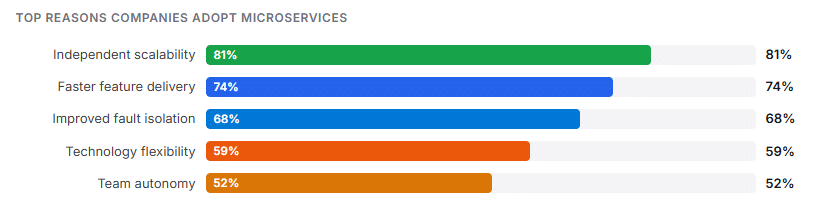
Microservices are not the right starting point for every project. The complexity cost is real, and teams that adopt the pattern before they are ready often end up with a distributed monolith: all the operational overhead of microservices with none of the independence. The table below helps identify whether the timing is right.
| Signal | Recommendation | Reasoning |
|---|---|---|
| Team of 2–5 engineers, early product | Start with a monolith | Operational overhead outweighs the benefits at this scale |
| Distinct domains with different scaling needs | Strong candidate | Per-service scaling delivers immediate cost and performance value |
| Multiple teams working on the same codebase | Strong candidate | Service ownership removes deployment coordination bottlenecks |
| Frequent deployments blocked by release coordination | Strong candidate | Independent deployability is a core microservices benefit |
| No CI/CD pipeline in place yet | Invest in CI/CD first | Microservices without automation become an operational burden |
| Monolith with clear domain boundaries already identified | Good time to migrate | Boundary clarity is the hardest prerequisite; if you have it, migrate incrementally |
For teams already operating in the cloud and looking to deepen their cloud computing strategy, microservices, paired with a strong digital transformation approach, consistently deliver greater agility and lower long-term costs than monolithic alternatives. The key is patience with the transition: migrate incrementally, invest in observability early, and let team structure guide service boundaries.
Coderio’s engineering teams design and implement microservices architectures on Azure, AWS, and GCP. From greenfield systems to incremental monolith migrations. Let’s talk about your architecture.