Dec. 02, 2025

20 minutes read
Share this article
Last Updated August 2026
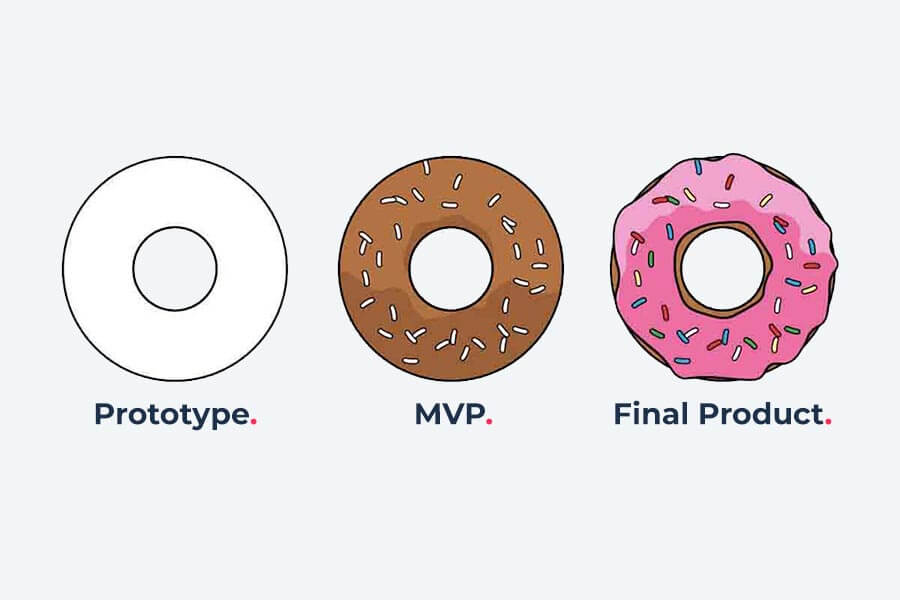
Prototypes and MVPs get used interchangeably in planning meetings, and the confusion is expensive. They look similar from the outside, since both are early, both are smaller than the finished product, and both exist to reduce risk. But they answer different questions, they cost different amounts, and building one when you needed the other is among the most common ways a product budget gets spent proving something nobody was uncertain about.
This guide covers what each one is, the types of each, the differences that change your plan, when to use which, and how to combine both in sequence.
A prototype is an early simulation of a product that shows what it will look like and roughly how it will behave, built to test ideas before money goes into full development. It looks like the product but does not work like it: behind the screens there is no database, no authentication, no business logic, and often no code at all.
The defining property is that a prototype is disposable. You build it expecting to throw it away, which is exactly what makes it fast and cheap. The moment a team starts treating a prototype as an asset to preserve, it stops being a prototype and becomes a liability.
Fidelity is not a quality scale. It is a match between how finished something looks and what question you are asking. Nielsen Norman Group’s guidance on prototype fidelity makes the tradeoff explicit: higher fidelity buys more realistic feedback and costs more to change.
| Type | What it is | Best for | Effort |
|---|---|---|---|
| Low fidelity | Paper sketches, wireframes, whiteboard flows | Information architecture, navigation logic, parallel concepts | Hours to days |
| High fidelity | Detailed visuals, real color and branding | Usability testing, sales demos, engineering handoff | One to three weeks |
| Interactive | Clickable screens users move through as if real | Task flow validation, terminology testing, finding UX problems | Three to seven days |
The common mistake is jumping to high fidelity immediately. Polished visuals suppress the feedback you most need, because when a screen looks finished, people critique button colors instead of questioning the workflow. Nielsen Norman Group’s work on parallel design found that exploring several rough alternatives at once beats iterating on one polished direction, and paper prototyping is the cheapest way to make that affordable.
A note on tooling, because most advice on this is now out of date. Figma covers low through interactive fidelity in a single file and is the practical default. Adobe XD has been in maintenance mode since the Adobe and Figma merger was abandoned in December 2023, and InVision shut down its core services at the end of 2024, so both should come out of any process documentation that still lists them. Framer and Webflow suit prototypes that double as a landing page, and Balsamiq remains the fastest route to deliberately rough wireframes.
Prototypes catch design problems early, when changing them costs a conversation instead of a sprint. They reduce miscommunication, because a shared artifact ends more arguments than any specification document. And they improve the user experience before a single line of production code exists.
The efficiency is well documented. Nielsen Norman Group’s finding that five participants surface roughly 85% of usability problems means a serious round of testing costs days, not months. Two rounds of five catch nearly everything worth catching. Combined with a structured approach to design thinking, that is the cheapest risk reduction available in product development.
What a prototype cannot tell you matters just as much. It cannot tell you whether anyone will pay, whether the experience holds up under real latency and messy data, or whether users return in week four. Nobody retains against a simulation, and enthusiasm in a moderated session is the most optimistic signal in product research.
Practical rule: if the question can be answered by watching someone use a screen, prototype it. If the question involves money, retention, load, or data, you need something real.
A minimum viable product is the smallest complete version of a product that delivers real value to real users in production, released to test whether the business hypothesis survives contact with the market.
Steve Blank’s writing on the minimum feature set framed it as the smallest set of features that earns a purchase from an early customer. Eric Ries, who popularized the term, defined it in his MVP guide as the version enabling a full turn of the build, measure, learn loop with least effort. Marty Cagan’s critique of MVP practice is the counterweight worth reading: too many teams treat “minimum” as permission to ship something broken, when the operative word has always been viable.
Minimum means narrow scope, not low quality. An MVP that loses data or fails under load does not produce a clean signal, because when users churn you learn nothing about your hypothesis, only that your software was unreliable. Viable means one segment can complete one job end to end. If a user has to leave mid-task to finish in a spreadsheet, you shipped a fragment, and fragments produce unreadable data.
Most writing treats MVP as a single thing, which is why teams default to the most expensive version of it. In practice, there are at least six recognized patterns, and the cheapest four can produce a paying-customer signal in under a month.
| Type | How it works | Best when | Engineering |
|---|---|---|---|
| Smoke test | A landing page with a signup or preorder call to action, driven by paid traffic | You need demand evidence before committing | None |
| Concierge | You deliver the service manually to a few customers who know humans are doing it | The workflow must be learned before automating | None |
| Wizard of Oz | The interface looks automated; humans do the work behind it. See NN/g on the Wizard of Oz method | You want real usage behavior without the engine | Minimal front end |
| Piecemeal | Stitch existing tools together, with no custom platform | The value is in the workflow, not the technology | Integration only |
| Single feature | Build one capability to production quality and nothing else | One feature carries the value proposition | Real but narrow |
| Demo video | A recorded walkthrough of a product that does not exist yet | The concept is hard to explain, easy to show | None |
The implication is that “we need to build an MVP” is usually a premature conclusion. If the riskiest assumption is whether anyone wants the thing, a smoke test answers it in two weeks for the cost of ad spend. Reserve the single-feature build for after demand is evidenced.
An MVP produces the evidence a prototype cannot: whether people adopt without being walked through it, whether they return next week, whether they pay and at what price, which features they actually touch, and whether the architecture holds when data is real.
It also disciplines scope. Cut secondary personas, advanced configuration, brand polish, microservice decomposition, and automated billing without hesitation. Do not cut the completeness of the primary workflow, data integrity, authentication, backup and restore, or basic observability. Teams cut that last item most often, and shipping without instrumentation is running an experiment with no measurement device: you end with opinions rather than evidence.
Most comparisons stop at “one is a mockup and one is real software.” True, and not useful. These are the dimensions that change how you plan, staff, and budget.
| Dimension | Prototype | MVP |
|---|---|---|
| Purpose | Test design and usability | Test market and business viability |
| Audience | Recruited participants, moderated | Real customers, unmoderated, in context |
| Functionality | Simulated. No backend, no persistence | Working. Real data, auth, infrastructure |
| Quality bar | Good enough to elicit honest reactions | Production grade for its scope |
| Timeline | One to four weeks | Two to six months |
| Team | Designer, researcher, product lead | Full squad plus QA and DevOps |
| Output | Insight and a validated direction | Behavioral data, revenue signal, live product |
| Afterlife | Discarded once the decision is made | Grown, or deliberately killed |
The afterlife row catches teams. A prototype has no maintenance cost because it dies. An MVP is a commitment: from launch day you own uptime, support, patching, and every signed-up user’s expectations. That obligation almost never appears in the budget conversation.
A prototype exists to answer whether the design works. An MVP exists to answer whether the product should exist. Those are not degrees of the same question. A prototype can pass brilliantly for a product nobody will buy, and an MVP can sell steadily despite an interface that tests poorly.
Prototype feedback comes from recruited participants in a moderated session, which means the setting is artificial, and the participants are being helpful. MVP feedback comes from real customers acting in their own context with the option to walk away, which is why it is harsher and far more reliable. Testing a prototype with colleagues, friends, or investors produces warmth and no information.
A prototype simulates. Screens advance because someone linked them, not because a system decided anything. An MVP computes: it stores data, enforces permissions, handles failure, and behaves differently depending on what the user did last week. That difference is why a prototype cannot be promoted into production. It has no data model, no error handling, and no security posture, so converting one means rebuilding the foundation while inheriting shortcuts never meant to survive.
Budget conversations go badly when a prototype quote is compared to an MVP quote as if they were bids for the same work. The ranges below reflect typical nearshore engagements for a mid complexity B2B product, as planning anchors rather than quotes.
| Prototype | MVP | |
|---|---|---|
| Duration | Two to four weeks | Three to six months |
| Team | Designer, researcher, part-time PM | Four to seven: PM, design, engineers, QA, DevOps |
| Deliverable | Interactive flows, research report | Live product, instrumentation, runbook |
| Cost after delivery | None | Hosting, support, patching, iteration |
| Share of year one budget | 5% to 10% | 40% to 60% |
The last row is the one to internalize. Validation should consume a small slice of the annual budget and eliminate most of the risk in the large slice. Teams that invert the ratio are not saving money; they are moving the whole budget onto one unhedged bet. In its analysis of startup post-mortems, CB Insights found running out of capital topped the list at 70%, but treated that as the final cause of death rather than the root problem. The diagnostic reasons were poor product-market fit at 43%, bad timing at 29%, and unsustainable unit economics at 19%. All three are validation failures, and each is a way of overrunning a budget while proving the wrong thing.
Prototype when the interaction model is new to your users, when stakeholders disagree about what is being built, when the workflow is complex enough that you cannot predict where people will hesitate, or when you need something concrete for a sales or investor conversation before committing engineering.
Prototype also when the alternative is arguing. Two weeks of clickable screens settles disputes that three months of documents will not, and costs less than the meetings.
Build an MVP when the design question is already settled, and the live uncertainty is commercial: will people adopt, will they pay, will they stay. Three conditions should hold before you start. You can reach at least 50 relevant users within a month of launch, because an MVP with no distribution produces silence and silence is not data. The team has capacity next quarter for support and maintenance, since an MVP without that capacity is a future incident. And a written stop condition exists, naming what result would cancel the work and who decides.
If any of those three is missing, use the cheapest MVP type from the table above instead of a full build, or prototype and spend the time building the channel.
Six terms circulate in these conversations, and teams routinely use three of them for the same artifact. Aligning on vocabulary is not pedantry; it is how you stop shipping the wrong thing.
| Term | Question it answers | Audience | Duration |
|---|---|---|---|
| Proof of concept | Is this technically possible at all? | Engineering and architecture | Days to two weeks |
| Prototype | Is this usable and desirable? | Recruited users and stakeholders | One to four weeks |
| MVP | Is this viable as a business? | A real market segment | Two to six months |
| Pilot | Does this work inside one real organization? | One named customer or department | One to three months |
| Beta | Is a near complete product stable enough to release? | Self-selected early adopters | Weeks to months |
| MMP | Is this complete enough to sell at scale? | The full addressable market | After MVP validation |
The distinction people miss most often is MVP versus beta. A beta assumes the product is right and tests whether it is stable. An MVP assumes nothing and tests whether the product should exist. Calling a beta an MVP means the scope you meant to question is already committed. For the earliest stage, our guide to using a proof of concept for software success covers the mechanics.
Framing this as a choice is the wrong model for most products. The mature pattern is a sequence with explicit exit criteria, so each phase either earns the next or stops the spend.
| Stage | Duration | Exit criteria |
|---|---|---|
| Frame the assumption | One to two days | A falsifiable sentence, stop condition, and review date, in writing |
| De-risk the technology | One to two weeks, if needed | A written finding, not a demo, confirming the approach |
| Prototype and test | Two to four weeks | Participants finish the core task unprompted and ask when they can have it |
| Scope ruthlessly | One week | One segment completes one job end to end, nothing else in scope |
| Build, instrument, launch | Three to six months | Analytics live from day one and a numeric success threshold agreed in writing |
| Decide | Six to twelve weeks after launch | Persevere, pivot, or stop, on the date set before launch |
Stage three compresses well when the calendar demands it: the Google Ventures design sprint fits framing, prototyping, and testing into a single week. Marty Cagan’s product discovery writing and Teresa Torres’ opportunity solution trees both help keep stages one and four honest.
Stage six is the one teams silently skip. Without a scheduled decision point, the default is persevering indefinitely, which is how a failed MVP quietly becomes a legacy system.
When a team cannot decide, the underlying question has not been named. Score each row honestly and add the numbers.
| Question | Score 0 | Score 2 |
|---|---|---|
| Is the dominant risk technical, not commercial? | No, technology is routine | Yes, novel integration or unproven performance |
| Is the interaction model novel to our users? | No, established pattern | Yes, users have not done this before |
| Do we have evidence people will pay? | Yes, from sales or an existing product | No, willingness to pay is assumed |
| Can we reach 50 relevant users after launch? | Yes, the channel exists | No, distribution is unbuilt |
| Can the team absorb support next quarter? | Yes, capacity is reserved | No, everyone is allocated |
A score of 0 to 2 means the commercial question is live and you can move to an MVP. From 3 to 6, validate first, using a prototype or the cheapest MVP type depending on whether the uncertainty is experiential or commercial. At 7 or higher, you are not ready for production software, and the honest next step is a proof of concept or a smoke test.
MVP metrics applied to a prototype produce false confidence; prototype-style judgment applied to an MVP produces expensive anecdotes.
| Signal | Prototype | MVP |
|---|---|---|
| Comprehension | Task completion without prompting | Activation rate in the first session |
| Efficiency | Time on task, hesitation and backtracks | Time to first value, workflow completion |
| Desire | Unprompted requests for access | Week four retention, organic referral |
| Commercial | Stated willingness to pay, letters of intent | Conversion rate, realized revenue, churn |
| Technical | Not measurable | Error rate, latency, Core Web Vitals |
| Delivery health | Not applicable | Lead time and change failure rate, per DORA |
Stated willingness to pay deserves a warning label: it is the weakest signal in the table and the one most often treated as the strongest. People overestimate their own future behavior in interviews, consistently and in one direction. Treat it as a reason to continue, never as a reason to skip the MVP.
Dropbox is the canonical demo-video MVP. Before the sync engine was viable, the founders recorded a walkthrough of the product working as intended and posted it to a developer community, and signups jumped overnight. Nobody was testing usability, so this was not a prototype but a market test.
Zappos is the canonical concierge MVP. Rather than build warehouse infrastructure, the founder photographed shoes in local stores, listed them online, and bought each pair at retail when an order came in. Deliberately unprofitable and the fastest answer to whether people would buy footwear unseen. Airbnb began as a piecemeal MVP: a static page offering airbeds in the founders’ own apartment during a conference, which established that strangers would pay to sleep in a stranger’s home.
In all three, the polished prototype was skipped because the dominant uncertainty was commercial. Run the reverse test on your own plan: if the real question is whether people can use the thing, none of these patterns applies, and you should prototype.
Validation is a tool, not a ritual. Skip both when the problem is proven, and the solution is a standard pattern, when regulation already dictates the scope, when building costs less than validating, or when an existing product’s telemetry can answer the question from data you already hold.
A prototype is a non-functional simulation that tests whether a design is usable and desirable, shown to recruited participants. An MVP is working production software released to real customers to test whether the product is commercially viable. The prototype tests the experience; the MVP tests the business.
Prototype when the dominant uncertainty is experiential rather than commercial: a novel interaction model, disagreement about scope, or a workflow complex enough that you cannot predict where users will hesitate. The criteria that matter most are which risk is largest, whether a distribution channel exists yet, and whether the team has capacity to operate live software next quarter.
A proof of concept asks whether something is technically possible, is aimed at engineers, and produces a written finding rather than an interface. A prototype asks whether the design is usable and desirable, is aimed at recruited users, and produces research insight. An MVP asks whether the product is viable as a business, is aimed at a real market segment, and produces behavioral and revenue data. They retire technical, design, and market risk, respectively.
Dropbox’s early demo video and Zappos’ manually fulfilled shoe listings were MVPs: no polished interface, but real commercial signal from real buyers. A clickable Figma flow tested with six users in a moderated session is a prototype: rich usability insight, zero evidence anyone will pay. The distinguishing test is not how finished it looks but whether a real customer could transact.
From a prototype: task completion without prompting, time on task, hesitation and backtrack points, terminology confusion, and unprompted requests for access. From an MVP: activation rate, time to first value, week four retention, conversion, realized revenue, churn, plus technical health such as error rate and latency. Stated willingness to pay belongs in the prototype column and should never be mistaken for a purchase.
A prototype typically takes two to four weeks with a designer, a researcher, and a part-time product lead, and has no technical requirements beyond a design tool. An MVP typically takes three to six months with four to seven people including QA and DevOps, and requires real infrastructure: authentication, data integrity, backup and restore, and observability. The MVP also carries ongoing hosting, support, and patching costs that a prototype does not.
No. A beta assumes the product is right and tests whether it is stable enough to release. An MVP assumes nothing and tests whether the product should exist. Running a beta while calling it an MVP means the scope you meant to question is already committed.
However many are required for one defined segment to complete one job end to end, and not one more. That is often a single feature. Counting features is the wrong frame; completeness of one workflow is the right one.
Prototype versus MVP is not a question of which is better, but of which risk is most expensive to be wrong about right now. Design risk is cheap to retire and costly to ignore. Market risk cannot be retired without putting something real in front of people who can walk away, though as the six MVP types show, real does not have to mean fully engineered.
Teams that consistently ship products people pay for are not the ones with better instincts. They name the riskiest assumption before building, choose the cheapest artifact that can test it, write down what would change their mind, and schedule the moment they will look honestly at the result. That discipline costs a few weeks up front and routinely saves quarters.
If you are weighing which artifact to build next, our MVP development services and UI/UX design teams run this sequence with product leaders, from framing the hypothesis to launching an instrumented product. Book a discovery call, and we will pressure test your assumption before you spend against it.
Mike is an experienced full-stack marketing professional who brings deep experience in leadership roles for high-growth organizations in the technology space. For more than 15 years, he’s led successful marketing teams in Latin America and the USA. Specialized in Digital Marketing, with a strong emphasis on scaling B2B technology companies via growth marketing, he’s developed marketing initiatives for companies like Hewlett-Packard, Unilever, Coca-Cola, Mondelez, Chrysler, Beiersdorf, and Colgate.
Mike is an experienced full-stack marketing professional who brings deep experience in leadership roles for high-growth organizations in the technology space. For more than 15 years, he’s led successful marketing teams in Latin America and the USA. Specialized in Digital Marketing, with a strong emphasis on scaling B2B technology companies via growth marketing, he’s developed marketing initiatives for companies like Hewlett-Packard, Unilever, Coca-Cola, Mondelez, Chrysler, Beiersdorf, and Colgate.
Accelerate your software development with our on-demand nearshore engineering teams.