Dec. 02, 2025

13 minutes read
Share this article
Last Updated December 2025
Building a successful product requires careful planning at every stage. One of the most important early decisions you’ll face is whether to create a prototype or develop an MVP (Minimum Viable Product). Understanding the differences between these two approaches can shape your entire product development strategy and determine how effectively you bring your idea to market.
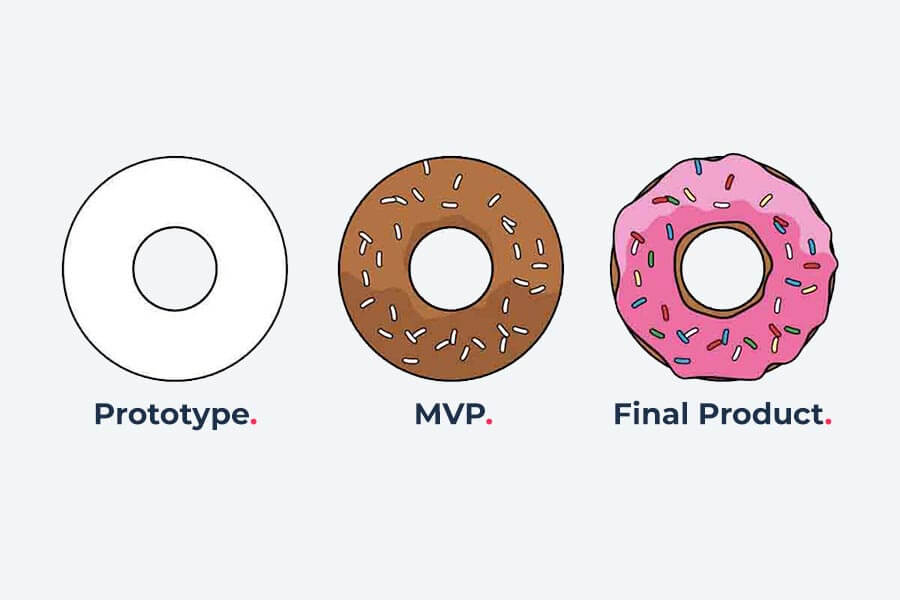
Prototypes and MVPs may appear similar on the surface, but they serve distinct purposes in early-stage product development. A prototype helps you test design concepts and visualize user experience before committing resources to full development. An MVP, on the other hand, is a functional product with just enough features to attract real users and validate market demand. This article breaks down the key differences between prototypes and MVPs, explains when to use each approach, and shows you how they can work together to strengthen your product development process.
A prototype is an early version of a product that shows what it will look like and how it might work. You create prototypes to test your ideas before you spend money on full development. They help you see if your product makes sense and if users will understand how to use it.
You can make prototypes using tools like Figma, Adobe XD, or InVision. They range from simple paper sketches to detailed digital designs. The main goal of prototyping is to test design concepts and gather feedback from users and your team.
Prototypes help you spot design problems early. You can test your wireframes and design concepts before you write any code.
You reduce miscommunication between your team members. When everyone sees the same prototype, you avoid misunderstandings about what you’re building.
Prototypes improve your UI/UX design through rapid prototyping. You test different versions quickly and pick the one that works best for users.
An MVP (Minimum Viable Product) is a simplified, functional version of your final product. It includes only the core features needed to solve the main user problems.
You release an MVP to a limited market segment to validate product-market fit. The goal is to collect user feedback from real users and learn what works before investing more resources. Unlike a prototype, an MVP is a real working product that early adopters can actually use.
When you build an MVP, you focus on core functionality rather than every possible feature. This approach helps you test demand and understand if your product solves a real problem. You can use tools like React or Bubble to speed up MVP development and get to market faster.
An MVP gives you several key advantages during product development:
A prototype serves to test design concepts, demonstrate functionalities, and collect initial feedback. You can use it for internal testing and stakeholder presentations before moving forward with development.
An MVP is built to test your product’s core functionalities with actual users. It functions as a real product in a limited capacity, allowing you to validate your concept in the market.
Prototype audience:
MVP audience:
The key difference is that prototypes stay internal while MVPs reach your actual customers.
Prototypes are often limited in functionality. They are usually interactive but not fully functional. You can click through screens and see how the product might work, but the features don’t actually perform real tasks.
MVPs contain core, usable features that solve the main problem for users. They provide an authentic product experience with real functionality that users can test in their daily lives.
| Aspect | Prototype | MVP |
|---|---|---|
| Cost | Relatively low | Higher investment required |
| Time | Quick to create | Longer development process |
| Resources | Minimal team involvement | Full development team needed |
Prototypes are cheaper and faster because they only involve a basic product version. MVPs require more time and resources since they must include essential features and be functional and reliable.
You should choose a prototype when you’re in the early stages of the product development process. A prototype helps you validate assumptions about design and user experience.
Use a prototype in these situations:
Prototypes offer several practical advantages when developing a new product. They give you a tangible model to work with before investing in full development.
An MVP fits your development process when you’re ready to test core functionality with actual users. This approach gives you speed to market while minimizing risk.
Launch an MVP when you need to:
An MVP helps you move from your initial concept to market launch quickly and efficiently.
You can use both tools together to build better products. Start with a prototype first to explore your ideas and see what works. This early model helps you visualize the product and gather initial feedback without spending too much time or money.
Next, you refine the prototype into a more polished version. This step adds better visuals and interactivity to test your concept more thoroughly.
Once you validate your idea, you move to building an MVP with real functionality. This approach aligns with The Lean Startup methodology by Eric Ries, which emphasizes iterative development and learning from users. Your MVP goes to actual users who provide real-world feedback.
You then use this feedback for iterative improvements, making changes based on what you learn. This feedback and iteration cycle continues until you reach a full-featured product. The phased approach keeps costs down and reduces risk while improving your product at each stage.
A prototype works best when you’re exploring ideas during product discovery. You can test design concepts and user interfaces without building real functionality. This approach helps with early risk mitigation by catching design problems before investing in development.
An MVP fits your needs when you’ve finished validating your concept internally. You’re ready to test with real users in the market. Your focus shifts to proving that people will actually use your core features.
Product management teams often use both tools in sequence. Start with a prototype to refine your design and user experience. Then build an MVP to test market demand with working features.
| Choose a Prototype | Choose an MVP |
|---|---|
| Brainstorming phase | Validated concept ready |
| Testing design ideas | Testing market demand |
| Internal feedback | Real user feedback |
| Quick visualization | Working functionality |
Your timeline and resources matter too. Prototypes require less time and money upfront. MVPs need more investment but give you actual market data.
Choosing between a prototype and an MVP depends on where you are in your development journey. A prototype works best when you need to visualize your concept and gather internal feedback on design and functionality. An MVP is the right choice when you’re ready to test your product with actual users in the market.
You don’t have to pick just one approach. Many successful products start with a prototype to refine the design, then move to an MVP for market validation. This combination helps you reduce risks and make smarter decisions about your resources.
Your choice should match your current goals. If you need to align stakeholders and test usability, build a prototype. If you want to validate demand and gather user feedback, launch an MVP.
Both tools play important roles in turning your idea into a market-ready product. If you want to learn more, there is another stage that comes before all this: Proof of Concept.
A prototype is an early model that shows how your product will look and feel. It helps you test design ideas and user interactions before writing code for a full product.
An MVP is a working product with basic features that real users can actually use. You release it to the market to learn if people will pay for your solution and how they use it.
The key difference is that a prototype is usually non-functional and used internally. Your MVP is functional and goes to real customers. Prototypes answer “Can we build this?” while MVPs answer “Should we build this?”
You should build a prototype when you need to:
You should build an MVP when you need to:
Key decision factors:
| Aspect | Proof of Concept | Prototype | MVP |
|---|---|---|---|
| Primary Purpose | Prove the idea is technically possible | Test design and user experience | Validate market demand |
| Functionality | Minimal or none | Limited to no functionality | Core features work |
| Audience | Internal team and stakeholders | Internal team and test users | Real customers |
| Scope | Single technical question | Design and usability | Essential features only |
| Validation Goal | Can we technically build this? | Will users understand and like this? | Will customers pay for this? |
| Fidelity | Very low | Low to medium | High |
A proof of concept tests if a technical solution is even possible. You might build one to see if an algorithm works or if two systems can integrate.
A prototype shows what your product will look like and how users will navigate it. You use it to get feedback on design choices.
An MVP delivers actual value to users and tests if your business idea works in the real world.
Prototype Examples:
MVP Examples:
The distinction is clear: prototypes don’t actually work for real use cases. MVPs deliver a basic version of the core value to real users.
Prototype Feedback and Metrics – You should collect qualitative feedback about design and usability:
MVP Feedback and Metrics – You should track quantitative data about real usage and business viability:
Key Difference:
Prototypes give you opinions and reactions. MVPs give you behavior and numbers. You ask prototype testers “What do you think?” but you watch MVP users to see what they actually do.
Timeline Comparison:
You can create and iterate on prototypes quickly because you’re only designing screens and flows. MVPs take longer because you need to write code, test functionality, and ensure things actually work.
Technical Requirements:
| Requirement | Prototype | MVP |
|---|---|---|
| Working code | Not needed | Required |
| Database | Not needed | Usually required |
| User authentication | Not needed | Often required |
| API integrations | Not needed | May be required |
| Hosting infrastructure | Not needed | Required |
| Security measures | Not needed | Required |
| Performance optimization | Not needed | Important |
| Bug testing | Minimal | Extensive |
Your prototype team might just need designers. Your MVP team needs developers, QA testers, and possibly DevOps support.
Mike is an experienced full-stack marketing professional who brings deep experience in leadership roles for high-growth organizations in the technology space. For more than 15 years, he’s led successful marketing teams in Latin America and the USA. Specialized in Digital Marketing, with a strong emphasis on scaling B2B technology companies via growth marketing, he’s developed marketing initiatives for companies like Hewlett-Packard, Unilever, Coca-Cola, Mondelez, Chrysler, Beiersdorf, and Colgate.
Mike is an experienced full-stack marketing professional who brings deep experience in leadership roles for high-growth organizations in the technology space. For more than 15 years, he’s led successful marketing teams in Latin America and the USA. Specialized in Digital Marketing, with a strong emphasis on scaling B2B technology companies via growth marketing, he’s developed marketing initiatives for companies like Hewlett-Packard, Unilever, Coca-Cola, Mondelez, Chrysler, Beiersdorf, and Colgate.
Accelerate your software development with our on-demand nearshore engineering teams.